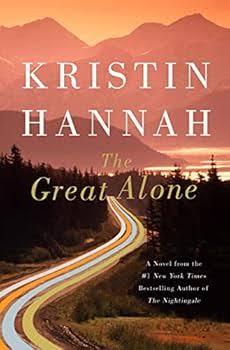
The Great Alone by Kristen Hannah is about a girl who moves to Alaska with her toxic parents and gets stuck in their abusive dynamics. The first two thirds of the book she is miserable and abused; the final third of the book she is miserable but not abused.
Who recommended this book: My best friend in North Carolina! KC Beecham. Our kiddos were in preschool together and we went to church together at Milford Hills. KC is a fantastic teacher and I miss hanging out at the lake with her.
What did I think:
I didn’t like this book. The writing itself was…capable. The plot felt realistic. The characters were flat. The setting was stunning and beautifully crafted. Let’s dive deeper.
Alone is a character centric novel which delves into the relationship between Lani and her mother, Cora. Lani starts out as a 14 yo, but the book time jumps twice so we see her at 17, and then 25 as well. Lani’s father was a POW in the Vietnam war but returns home and pulls the family into emotional chaos.
There are no healthy attachments in this book. Lani and Cora are codependent; Cora and her husband are stuck in a toxic abuse cycle; Lani and her eventual love interest, Matthew are trauma bonded. Nobody has boundaries or any semblance of communication skills. I mentioned that the plot feels realistic—the first two thirds of the book is mostly the mother and daughter tiptoeing around the increasingly volatile husband/father—but that didn’t make for a fun read.
The thing about abuse as a story line—and it is the central focus of this novel—is that staying in a cycle of abuse is fundamentally an act of passivity. Passive characters are inherently unlikable and boring. As a reader, I want the plot to move forward and the passive character is the reason it’s not. Abuse is also predictable which doesn’t help the pace of the story. I end up feeling guilty for disliking the abused characters and blaming them for not walking away already.
The author does little to explain the background for the co-dependence between Cora and her husband. Cora grew up wealthy and rebelled at her upper-class parents, met her future husband and got pregnant, and based on a few pre-war years of happiness has stuck things out hoping that life would return to what it once was. We get no backstory on abusive dad, only that he was different after the POW experience and drinks too much. Because we don’t actually see the “before”, we the readers are left to rely on the author’s “trust me!”
So a moment on dad before we move on. There is nothing redeemable about this character. He drinks, wastes money, hits his wife, emotionally terrorizes everyone, picks fights with minor characters, doesn’t protect his animals, and is a conspiracy nut. Sure he is “movie star handsome” but that is only mentioned once. Throw in a heap of PTSD and untreated alcoholism and you have a generic bad husband/father. The problem with a character like this is that Cora is an idiot for staying with him. Therefore as a reader I am back in the blaming Cora for being dumb and putting her kid in a trauma situation.
When writing an abusive situation, an author needs to give the victim a reason for staying that feels like it is a difficult choice. If Cora had horrible abusive parents and her husband was a better option at the time, or if he was charismatic and capable and the abuse was more subtle (until it isn’t and then we have the end of the second act explosions) then it would make Cora as a character more sympathetic. Instead we get stuck in a loop of “maybe it will be better this time” for 280 pages.
Lani, as she grows older, realizes the extent of her parents’ abusive dynamics but fears that leaving will get her mother killed. As a character, Lani is the most well developed but even so she lacks any clear goals beyond “keep mom from dying”. This makes the second half of the book less believable when she is sneaking around behind her dad’s back to hook up with the boy she is madly in love with. Again the author asks us to believe that the love between the two characters is so magnetic that nothing can keep them from each other.
Alone relies heavily on tropes. Unfortunately instead of augmenting the predicable with interesting character traits or compelling backstory, the author piles on more abuse scenes.
Kristen Hannah isn’t a bad writer. Her scene writing is balanced and boy can she write place descriptions. This book feels like a love letter to Alaska. As someone who spent most of my high school summers working in Alaska, it was like stepping into the world. I don’t know much about Alaska in the ’70’s but the historical representation felt plausible.
Maybe that is what was so frustrating about this book: there was no reason that I couldn’t have enjoyed it. If the author had put a tenth of the work into her characters or plot that she did in the setting, this could have been a much better read.
Who would I recommend this book to: People who like to hate on abuse victims. It will bring out the ire. I don’t actually know anyone like that personally, but if I meet one I will recommend this book.
Violence: 5 out of 5
Sex:2 out of 5 but nothing graphic
Child abuse and neglect: 3 out of 5 (emotional and physical abuse, and neglect.)
Writing Prompt: Gina decides to fake her death.
 Mamasquatch the Writer
Leave a comment