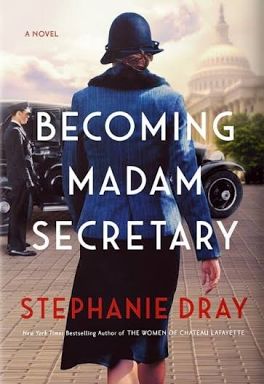
Becoming Madame Secretary by Stephanie Dray, is a fictionalized biography of Frances Perkins, the first female cabinet member and the force behind the Social Security Act—and many other historically significant political moments.
Who recommended this book? Anna! My dear friend and godmother to Linden. Anna is an extraordinary organizer with a creative streak, who has recently taken up team boat rowing.
What did I think of this book? I learned a great deal of important history while reading, and this coming from a history fan. As a Hisfic writer myself I understand the balance of accuracy vs. entertainment; the author sometimes made some weird choices in these matters.
Francis Perkins was a fascinating woman. She legitimately spear headed or contributed to massive labor reforms and social programs that kept democracy rolling. Yet the author chose to write in first person which boxes the narration into her take on Perkins’ personality. Now, Perkins may have been as humble and self-effacing in real life as she was on the pages of this book, but that meant that several times something big happened off page and we get a throw away line about it. I wanted to hear the character’s reaction to getting the vote!
The other issue that I had with the book is that the author spends an inordinate amount of page time letting Perkins dither on about whether or not she is going to marry, and whom. The problem is that there is no progression, it is just spiraling and restating her reluctance until she finally decides and quickly marries the obvious choice. Her husband does become an important part of the story, but he is fairly quickly relegated to a plot point. Basically, I would have preferred more word count on the historical moments.
What brought tears to my eyes was the history. This book is loaded with historical moments that are still affecting my life today and seeing their beginnings and the heroic efforts of good hearted people who fought to bring about positive changes for so many Americans was moving. The author wove a beautiful historical narrative—around the events.
Unfortunately, Dray asks too much of her character. Perkins is portrayed as a woman who personifies the North Eastern Puritan Sensibilities. Deeply religious (Perkins is now an Episcopal Saint), deeply moral, low self esteem, high self-efficacy (with imposters syndrome?), possibly Queer but maybe not, Contentious but soft-spoken when egos needed to be stroked…
It was impossible to bond with Perkins as written because she was never flawed…or at least not on paper. Not that the real Perkins was a terrible person, but there seemed to be a lack of nuance. In the author’s note Dray explains why she made the choices she did—the woman did A LOT and there are only so many pages—but I was left wanting more of the history and less of the Character Perkins input.
I think most of the issues I had with this book could have been fixed by putting it in third person. No one wants to listen to an overly formal self-effacing woman explain why she was so hesitant to _____________, and then FDR/her husband/any number of her friends talked her into it—over and over and over again. I wanted the character to live up to the real person and trying to recreate their voice and thoughts in first person made that difficult.
But I did like the book.
Who would I recommend this book to?
Anyone who likes a fictionalized biography, or who likes historical fiction from this time period. I am going to read an actual biography of Francis Perkins and make a comparison at some point, but in general the author does a great job of capturing the historical elements. I handed this one off to Violet, so stay tuned to see a teen girl reaction.
Sex-some chaste kissing followed by accusations of being a harlot
Violence-Descriptions of Triangle Shirtwaist Factory Fire, squalor, and children with malnutrition
Profanity-none
Writing Prompt: Choose a historical person and find out three or four facts about them. Create a scene and incorporate the details…or just make stuff up!
 Mamasquatch the Writer
Leave a comment