Moss and I headed up to Vancouver for a Sabaton concert this week and we took the opportunity to listen to several podcasts about the Salem Witch Trials. It happened to be the topic of the week in our US history through novels class and getting either kid to read The Witch of Blackbird Pond wasn’t going well.
I spent quite a bit of time Hyperfocusing on the Salem Witch Trials a few years ago. They play a background role in my first novel and I read the requisite books on the topic and even took a side trip to Salem with Pepper on my first research trip. While I’m by no means an expert here are the basics.
In the winter of 1691/92 in the village of Salem, several girls began acting out. They blamed their behaviors on witches and the devil. More and more people were accused, those who confessed were spared while 19 who maintained their innocence were hung or crushed to death. Five more died in prison. When at last the new governors wife was named, the governor rolled his eyes and forbade spectral evidence; things died down fairly quickly.
Some of the hypothesized reasons behind the events in Salem:
1. Trauma. This is the middle of nearly 100 years of conflict with the Indigenous peoples of the area. As colonists overtook more and more of the Indigenous lands, raids and kidnappings for retribution and ransom money became fairly common. The colonists lived in fear. Many fled south and stayed with relatives or relocated all together. They brought the trauma with them.
2. Boredom. This argument is somewhat controversial and formed by a modern feminist lens. While it’s true that girls were limited as to their life options, they didn’t have a contrasting model. It is also not historically accurate. While women and girls were largely relegated to the domestic sphere, there were opportunities for socialization. Husking parties, church events, and community get togethers were common especially in villages.
Congregationalists believed in educating both sexes, and books were hardly rare—though this depended largely on socio-economic status. In a house with three 9-12 year old girls and no small children to mind, girls would have been kept busy learning how to keep a home, manage servants or enslaved members of the household, and be educated in religion.
3. Community disputes. Reverend Parris, father and uncle to the original accusers was a deeply unpopular man who was owed backpay in the form of firewood. Firewood wasn’t exactly easy to come by given that it often meant wandering through the woods where you might get knocked on the head and drug off to Canada. In general, many of the women initially accused were fringe members of the community or had made some questionable life choices for the times.
4. Mass hysteria. This was a time when people legit believed in the devil and his minions working against the good of humanity. If something bad happened it was likely the devil had a hand in it. Once things got rolling, it was easier to go along with the crowd than be the one to hold up a hand and say “Um excuse me…” especially when those who did were often the next accused.
Now obviously the above reasons are simplified, but some of the podcasts I listened to not only simplified the likely reasons but presented historically inaccurate additions. The most common were:
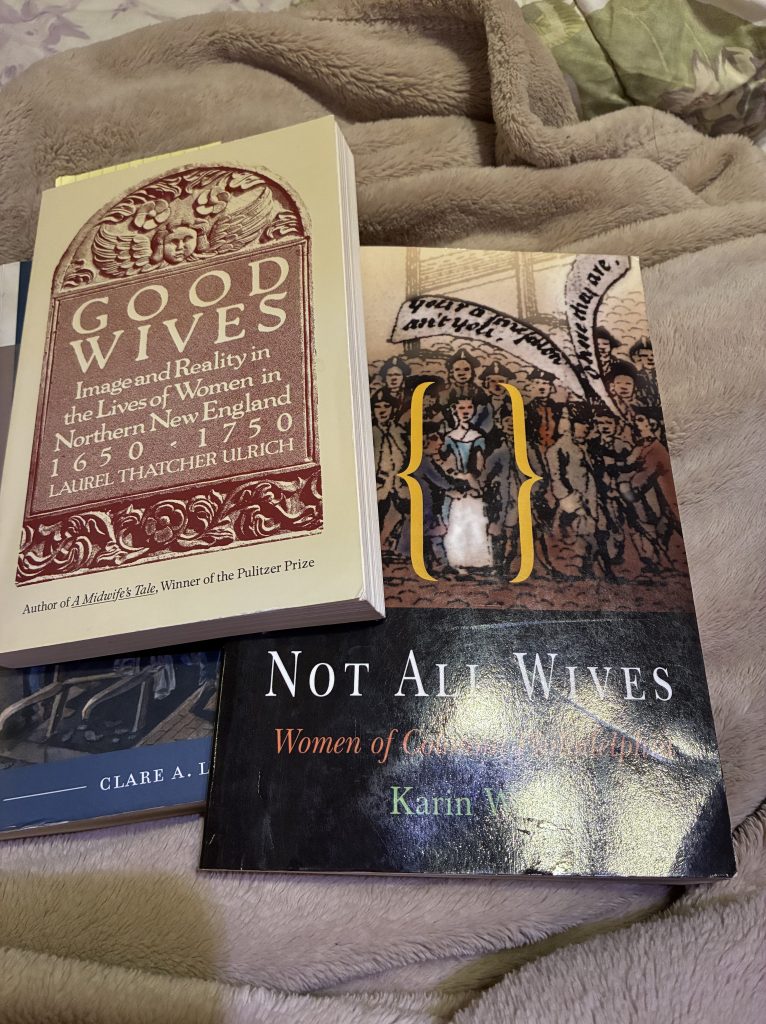
1. Boredom as above but also that women were far more oppressed than men and this was a proto-feminist reaction. There is a great book Not All Wives by Karin Wulf, which describes the role of Colonial Women within and outside the bounds of Marriage, which shows that many women in Colonial New England lived far outside the boxes that modern non-historians like to place them in.
Colonial life was hard scrabble for just about everyone. Voting wasn’t a thing. Women did have legal rights, and plenty of people of all classes were getting in trouble for all sorts of shenanigans. We are nearly 100 years away from the Constitution and anyone having much of a representational voice in anything. Feminism as we know it didn’t exist, though there were murmurs in Europe within some of the more elite social circles.
2. Mass poisoning. Some folks claim that a toxic bread mold caused the hysteria. Or Aliens. Or the devil really was at work…not so much the podcasts I listened to, but I’ve heard the conspiracies.
What surprised me most about most of the podcasts I listened to is that they all seemed to try and offer a nuanced approach to the topic? For a while there the accusing girls were all totally vilified. Then there was some back swing on “maybe they had a good reason or Reverend Parris was the one orchestrating the whole matter”. Now it seems that we are reaching a middle ground. “Yes there were external forces at work—trauma, community and religious pressures—but these girls never the less got twenty people killed and the community went along with it.”
I hope that the next step goes a little deeper into the historicist lens; lets look at common behaviors and attitudes of the day from primary source documents and let that inform our reading of the situation as well.
Ask questions like, what are women being fined for? What are preachers preaching against? What are birth rates and marriage rates doing? What are popular novels of the day discussing?
Once we begin looking outside of the simplistic histories created by (white) men with a vision to sell, we can start piecing together a more nuanced vision of what history looks like.



Leave a Reply