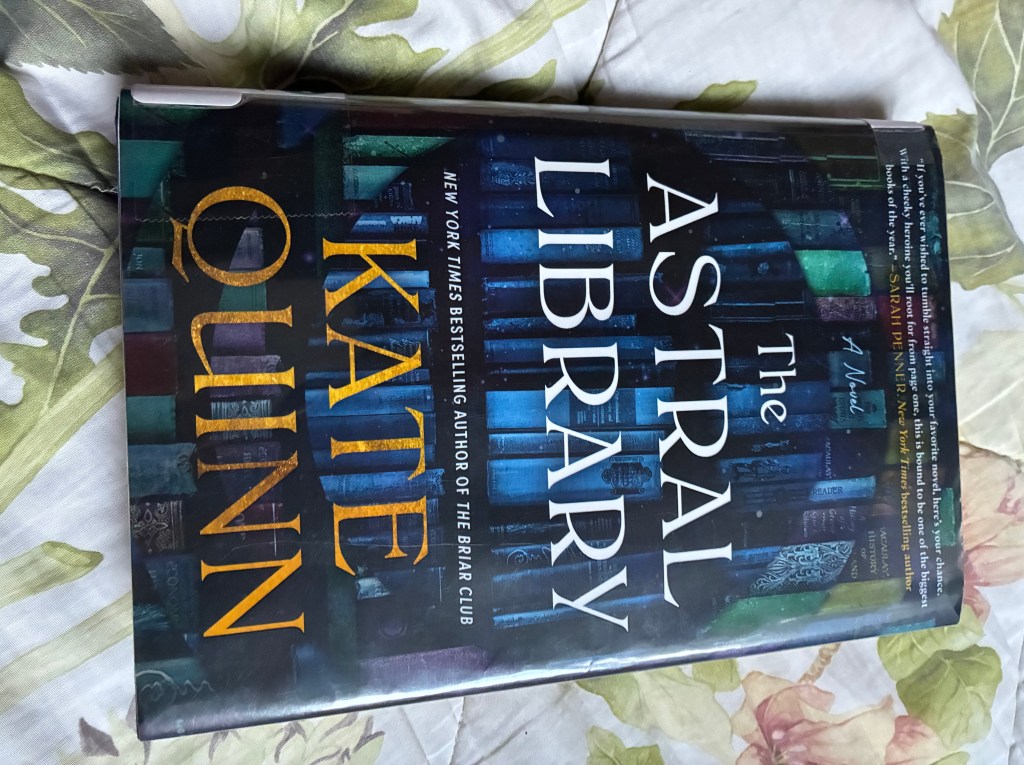
The Astral Library by Katy Quinn is a fantasy book. Alix is a down on her luck former foster kid who finds herself in a sentient library that allows patrons to live in books as background characters. When the library comes under attack, Alix must act.
Who Recommended this book? My friend, Kari. Kari and I met through Girl Scouts and we are kindred spirits on many levels. Kari is also a Cascadia expert and has made the world a better place in many areas.
What did I think of this book?
Well, I liked parts of it. In fact it covers a lot of my favorite things. Kate Quinn is obviously a historic costuming nerd and knows her stuff. The idea of a sentient library and being able to live in books is a great concept.
The book shines the most when the characters are interacting with other literary characters from the real world books. Quinn slips into fan-fiction territory in a delightful way. Unfortunately her own characters leave a lot to be desired.
Alix is a brilliant woman of 26 who holds down three jobs in three industries, and shows amazing research skills throughout the book. The reader is asked to believe that this same woman couldn’t get into a college and find money for it because of her foster care background.
There wasn’t one school counselor or social worker or college recruiter who mentioned to this girl that pell grants, and private scholarships for foster kids are abundant? This brilliant girl who spends all her time at libraries never once googled “college opportunities for foster kids”?
The book opens with Alix doing “poverty math” at the grocery store, and it is a great scene…except that food pantries and food stamps are also a thing. Quinn has just told us that Alix has no money to her name and can barely afford to sleep on her friend’s couch, but she makes too much for SNAP? (This book was published before the major funding cuts).
While I am fine with suspending belief for a good plot hook, it has to be consistent with character.
The love interest, Beau, is a multi-racial, bisexual, historical fashion expert who owns a clothing boutique in Boston. Half of his dialogue is about historical sewing (which is something I can talk about for days but somehow in this context it often dragged down the plot?) Beau is the most handsome and well dressed man ever, who doesn’t seem to have any character flaws. He sees Alix for who she is and likes her. So basically no tension or conflict there. The relationship plot felt inevitable and cliche—so why add it at all?
Speaking of tension: throughout the book Alix’s internal and external tension didn’t compliment each other therefore one didn’t inspire resolution in the other. Her mother abandoned her at age 8 and she is sad that no one ever chooses her. Mind you, Alix doesn’t really have discernible flaws either, other than being a size 22 which she doesn’t seem to mind—there are no physical drawbacks mentioned as part of the plot other than she has to go to Beau for costumes because nothing in the library is her size. (Now do I believe that there are hundreds of patrons in the books over thousands of years and they have never had a size 22 before?)
The external tensions revolve around someone stealing Alix’s identity (in a way that seems implausible), her introduction to the library, and then an attack which she must help defend. While Alix’s mother occasionally pops up as a plot point, the resolution on that occurs in an Afterwards. Sigh.
There is a lot of winking at the audience in this book. A lot of leaning into the stereotypes—of libraries, librarians, and the inevitable villains. No spoilers here, so let me just say that the antagonists are villains. They don’t have backstory; they don’t have reasons for their stated beliefs and actions. They show up and are basically caricatures.
Quinn has a great vocabulary—well Alix does—and the dialogue and structure are sound. The pacing drags at times because the characters feel like they are experiencing events rather than having meaningful growth. When those events drag we don’t have internal tension to fall back on.
I really wanted to love this book. Honestly, I wanted to like the book but found myself distracted by the author’s choices. I was pulled out of the narrative time and time again. The plot beats were predictable so there wasn’t a lot of tension and in the end it felt like I was reading the book to read it.
The most frustrating this is that there is a great book hovering underneath The Astral Library. The skill and components were there but somehow it never delved beneath the fluff. It was like the book started as a fun high concept that never grew the roots it needed to be anything more than a beach read.
Who would I recommend this to? People who like a cozy read. I can see a book club reading this and deciding which books they would like to live in. I was chatting with another friend this week about books and she mentioned that inconsistencies make her fixate on the one thing and she can’t enjoy the rest of the book. I get it. This is not the book for her, or those of us like her.
This is a book for people who don’t ask too many questions or think about the world that surrounds all the characters and how it impacts their lives and choices, which is ironic as the premise question is “Have you ever wished you could live inside a book?”
There is almost a quality of YA fiction to this book. There are some swears, talk of sex, and talk of child abuse and GBV, but I wouldn’t give it more than a PG-13 rating and maybe not even that.
Writing Prompt: Drop yourself as a character into a minor role in your favorite book.



Leave a comment