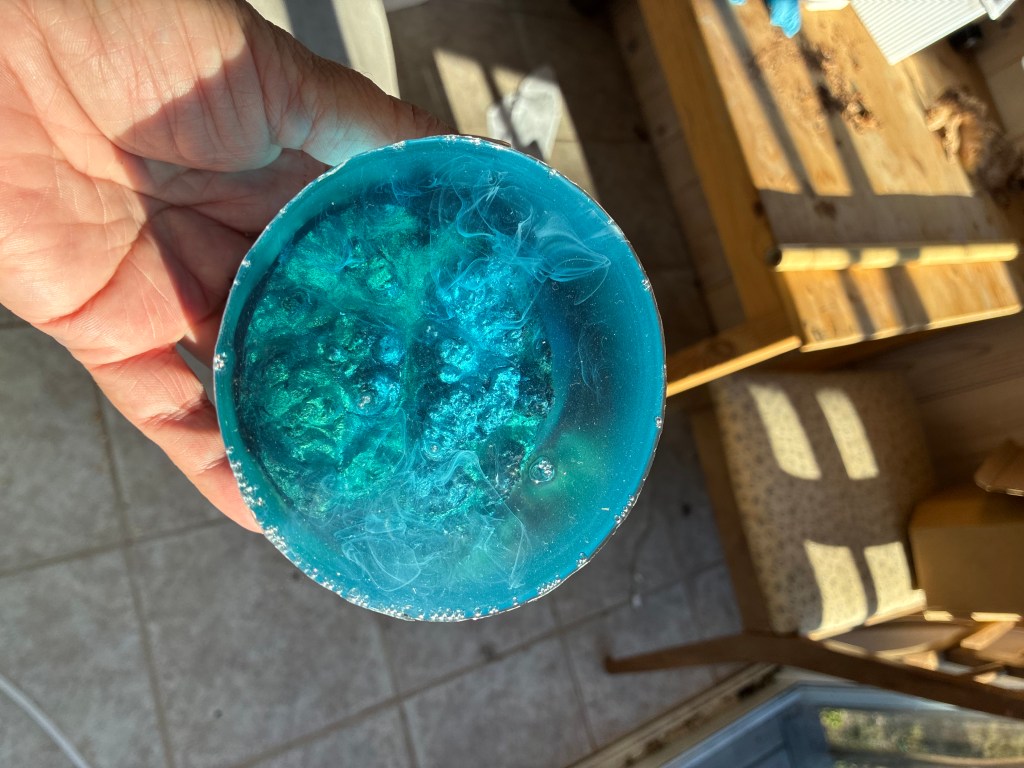
I am currently working on several projects in several mediums. Above is a resin cast burl that will be part of a wizard staff. But I’m also writing a novel in stories. The idea is that each chapter contributes to the longer narrative but can stand alone and be mixed up and read in any order. It is a challenge. I’ve read a few examples—mostly Louise Erdrich—so I know it can theoretically be done, but having never seen early drafts the “how” is a learning experience.
My novel in stories criss crosses about thirty five years, and is primarily from four perspectives, with an occasional side character chapter.
I started off by loosely outlining the entire thirty five years and figuring out which snippets were important. The way I see a Novel in stories it is like when someone starts to tell one story and tosses a throw away line in like “ that’s when the bear chase went down”. After the first story is done—or sometimes in the middle—you have to get the bear chase story. Eventually, enough stories have unfurled and you have the whole shebang.
To be fair, the first chapter I wrote was a pantser short story on a weekend writing retreat. Then I finished the project I was working on before coming back to do the outlining. During the between, I jotted plot ideas, characters, and world details down. The A plot is simple, but coming up with secondary stories that tie the A plot together has been far more difficult than I imagined.
A novel in stories, in someways, is like a collection of short stories. I am a long form writer. This project is really an exercise in short form writing and I am getting a lot of practice at simplifying. Three of my four characters have come along naturally, but one is kicking my teeth. I don’t have the relationship dynamics down; his character arc has changed, and I’ve yet to nail his vibe.
If one character isn’t right then readers are going to question why the other characters are behaving the way they are in relation to him. I don’t usually edit midway through a first draft, but halfway through I’ve done a basic redo just to help keep the plot rolling. I find that my plot unfurls based on the characters—sure they are going to join into the quest regardless, but how they get there depends on the interactions they’ve had in the moment. It’s all about consistency.
So it looks like there is some character work in my near future. That also means another timeline. I’ve been doing a lot of timeline work to keep things straight.
My slotted project after the current one is a short story, followed by another novel in stories—this time in the series I’ve been working on. The idea was that I get some practice before having a go with my familiar characters. At the moment I’m taking notes about what is helpful and what isn’t with my process. I don’t love to outline but this process would be nearly impossible without it. Within a historical fiction context I have a natural big world outline and it is more about finding the moments within the big world that my characters are acting. Fantasy doesn’t have those boundaries.
The helpful notes I have thus far?
Know the characters. Know their voices, their motivations, and their personal histories; these are the elements that will guide the plot.
Plot out your mysteries step by step. Know the clues, which order they are going to unfurl, and where. The interactions which lead to the unfurling can be pantsed, but you will save yourself a lot of time and energy by having a list to check off.
Don’t be afraid to go in and add more content. I just recently realized that I haven’t show enough relationship dynamics between key characters and an extra chapter would flush things out.
Sometimes you are jumping around timelines and sometimes you write chronological chapters that may be separated throughout the book. For my mystery chapters it was easier to write the chapters in a row to keep the cohesion fresh in mind. For other chapters—or even parts of chapters—I would jump to another part of the story to see what happened before I could write about the aftermath. It feels like a very ADHD way of writing which suits me fine.
Keep good notes. I have a folder with reference sheets for all sorts of things. Mystery clues, vocabulary, strange animals that are going to show up at some point. I have full character profiles and examples of voice for each person. The voice especially has come in handy when I haven’t written as that character for a few weeks. I can go in and read the paragraphs and slip back in.
So that is what is working thus far. I keep thinking I’ve rounded the corner on the first draft, but then find that I’m still only knee deep. I’ll keep you posted!
Happy Writing this week folks!
 Mamasquatch the Writer
Leave a comment