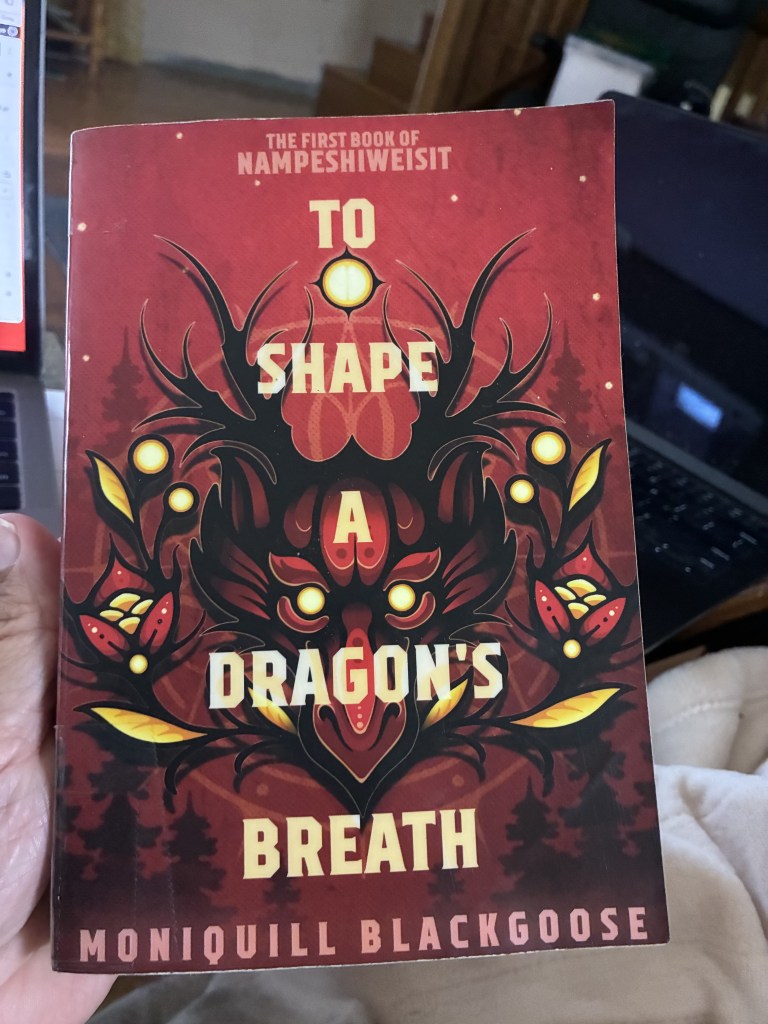
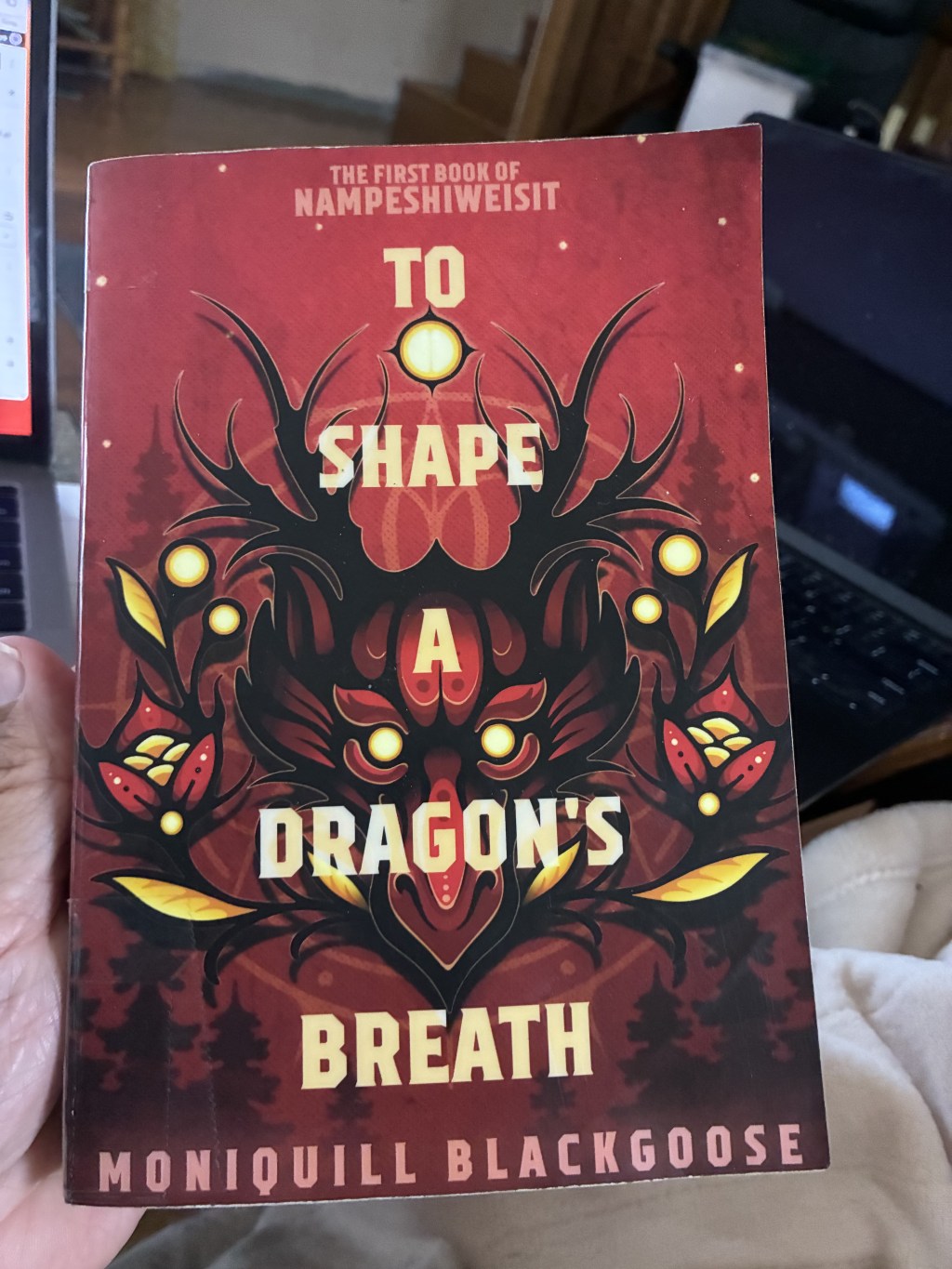
To Shape a Dragon’s Breath by Moniquill Blackgoose is a fish out of water story about an indigenous girl who bonds with a dragon and goes off to an English school for dragon handling. It is set in an alternate New England in the 1830’s.
Who recommended this book? Keith Weir, a guy I met in an Exvangelical Facebook group. He works at a bookstore and is a champion of unionization. Seems like a good dude.
What did I think of this book? I got strong Naomi Novak Temerair vibes from this book. It is the first in a longer series of an alternate history of the US territorial space. Except we get nothing of the dragon’s perspective but through the mind meld of the protagonist.
The plot is fairly standard YA fiction for the most part. Girl turns out to be exceptional, goes off to school and doesn’t fit in, makes friends and stays true to herself, things work out okay. The non protagonist characters are far more interesting than the girl they are circling around. Protagonist’s only flaw is that she is uncultured, but the culture she is not fitting in with is written to be so ugly that it doesn’t feel like much of a flaw. There is also a naïveté that feels terrible (as a reader who knows a lot of the real history) but I am afraid that it is author bias coming through rather than a purposeful facet of the character.
The author is indigenous herself and represents the complexity of the alt history cultures she is writing in a less nuanced way than I would have hoped. The culture the protagonist leaves —and frequently reminisces about—is egalitarian, community forward, and kindness is prioritized above all. It feels…unrelatable. I want a tiny crack in the facade to make the community feel like it could be real.
The world building is extensive. While the scene work and arenas are beautifully done, sometimes the author decides to spend pages on the intricacies of the chemistry system or the like. I skimmed. There is a lot of story telling as well which may or may not have been relevant to the plot. The first couple I read diligently, but as the protagonist interacted with other people from other cultures and asked them to explain to her their mythology…yeah I skipped those pages. The plot didn’t suffer for it.
To be fair however, the form of this book—with the story within the story—isn’t unfamiliar, especially in books written by Indigenous authors. We survived the Night by Julian Brave Noisecat is a woven memoir that incorporates mythology and the experiences of the author and his family. But each story feels important to the author; many of the stories being told to the protagonist of Dragon’s Breath feel like that are more exposition to explain things to the reader.
The author writes convincing relationships. The protagonist comes from a culture where marriage is fluid and multiple spouses of either gender are accepted and she sees no reason why she shouldn’t court both a female indentured servant and one of her male classmates. Her explanation of her reasoning was one of the few times the exposition about culture wasn’t bordering on tedious. The relationships themselves were paced well.
Friendships too were well written. The allies weren’t totally allied which is a nice change of pace from a lot of these stories. The dragons and the systems of their use were under explored. This will likely change as the students graduate from the school, but at this point in the series they feel like secondary plot devices to get the fishes out of water.
There is a lot of moving from place to place in this book. The chapters are short and sometimes we spend all of it following characters from place to place. again, many of the scene changes feel like they are for world building rather than plot pertinant to this first book.
What went right?
There are a lot of interesting moments hidden amongst the heavy world building. When we get to linger in one arena long enough to breathe and create some tension the character interactions have a chance to sing. The autistic character is sympathetically portrayed and may even be narratively important going forward? And the stripped down plot is really interesting; it is glossed over more than I’d have liked but it will undoubtably be important…eventually.
It is weird to have the first book in the series be a transition book. I feel like it was written to set up what comes next. In traditional speculative historical fiction series’ I like their to be far more integration of world and plot. This book was Harry Potter book one level of clunky. But then, Harry Potter got a lot better and I hope this will as well. I’m happy to delve into an inclusive dragon land, especially when the alternate history teller is one whose community is traditionally underrepresented.
Who would I recommend this to?
People who like dragon books. I do think this is worth the read. The world is compelling and I think it could be a really fun place for an author to play. If I didn’t have a fondness of dragons would I get into this series? Probably not.
Sex-Protagonist is Bi, kisses people of both sexes but fairly chaste. PG? Maybe?
Profanity-maybe a couple swearsies?
Violence-descriptions of race based wars and violent acts. Some physical violence between characters. Bullying. Lots of racism from antagonists. **
**A note here: If one is fairly ignorant of specific real world historical events and precedents, I don’t know that they would equate the Indigenous people in this book with Real Life Indigenous communities. So kids could read this book and not get the correlation ? Same with slavery and being indentured. The alternate history is just enough off and the book is labeled as “fantasy”.
Writing Prompt: Take your favorite historical event and add dragons.


Leave a Reply