In the first of our May Mystery posts we discussed plotting out our story. Today we are delving into building our characters. What sets apart a character in a mystery from that in say a romance or thriller?
Historically, our protagonists have been imbued with curiosity and a love of puzzles. They are driven to find explanation and order in chaos. They are highly intelligent—unless a combination of luck and incompetence are played for satire or comedy—and often all of these attributes combined make relationships difficult.
Most mysteries are plot centric, with the character arc happening as a result of the plot rather than the character arc being the plot. In the 1990 classic Caroline B. Cooney novel, The Face on the Milk Carton, protagonist Janie must discover the truth about her past. Through her discoveries (spoiler alert: she was kidnapped and grew up with parents not her own) Janie stops being the spoiled girl she is in the beginning of the novel. Much of the plot revolves around Janie uncovering the clues that lead her to making a hotline call at the end of the book—think 80% uncovering clues, 20% having feelings and reactions about those clues.
In non-teen fiction mysteries the 20-40% of B plot/character personal life and development often revolves around relationships and how the protagonist is bad at them. A character doesn’t have to have dysfunctional relationships—I love a romantic ally—but remember they can’t be “good” at everything. In real life the same qualities that make us strong in one area make us weak in another. I have nearly perfect pitch which makes me fabulous in a choir, but the same gift makes me hypersensitive to noises like crunching tortilla chips—one of my husband’s favorite snacks.
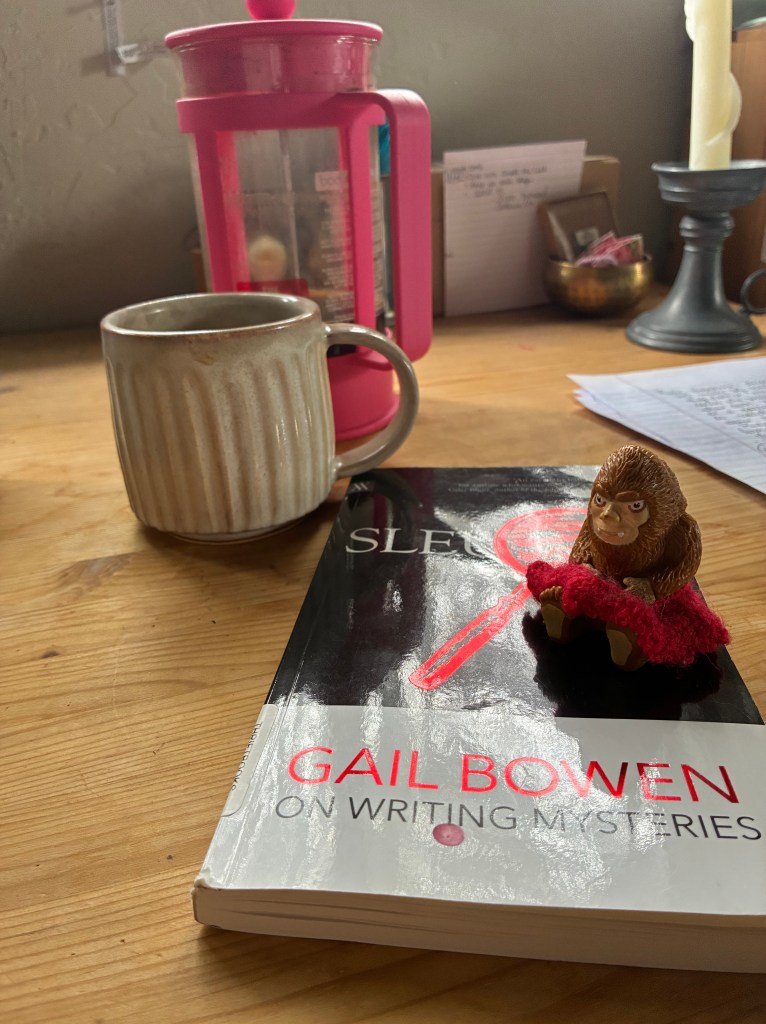
Gail Bowen has some wonderful exercises for building characters in her book Sleuth, and I won’t cheat you out of discovering those for yourself, but I will share this quote “Let your reader come to know your characters the same way we come to know people in our lives: by their words, by their actions and reactions, by what they say and what others say about them.”(75)
Our characters should be round enough to be compelling to those they come in contact with, on and off the page.
Bowen goes on to suggest to give your protagonist an ally or sidekick. I don’t know of many detectives who don’t have support team. Traditionally, the sidekick sees the flaws of the protagonist but loves them anyway. I think I prefer things to be a tad more complex. It is too easy to have a sidekick that feels flat because they lack goals or desires of their own.
Make sure that your Watson is benefitting from following around Holmes. Maybe they have an attachment disorder, maybe they are getting paid, maybe it is fame or notoriety they seek. Blind love or unflagging adoration is bad for tension; if a sidekick is benefitting from the situation it means there is a cost-benefit analysis happening. As the protagonist makes life more difficult, there is a potential for them to lose their sidekick. That potential for loss is what may (or may not) finally motivate the protagonist to change.
And finally, we have our antagonist.
Antagonists should mirror the protagonist. A good antagonist brings out the worst in the protagonist and shows what a few different choices might lead to.
And that’s what I’ve got for you today. It’s been a long week at the end of a long month but let’s keep on writing! Again, get a copy of Sleuth; it is well worth the read.

 Mamasquatch the Writer
Leave a comment