As someone who loves puzzles, I enjoy breaking just about anything down into visual organizers. Venn diagrams are my favorite— secondsies goes to the good old timeline— but a line graph is probably the most universally useful in showing changes over time.
Writing relationship arcs isn’t exactly a science, but there are commonly used formulas involved and they look great in line graph form. This week we are going to look at some visual diagrams that show how an author might use some of last week’s tropes to plot out their character’s romance trajectories.
Relationships on the page don’t necessarily reflect reality. Especially if an author is jumping in in the middle of the story and showing flashbacks! That said, an author needs to know the story from the beginning to the resolution to keep their story cohesive. Now, after all that gushing about line graphs one might think that’s where I’m going to start, but let’s sit back and look at a timeline for a moment.
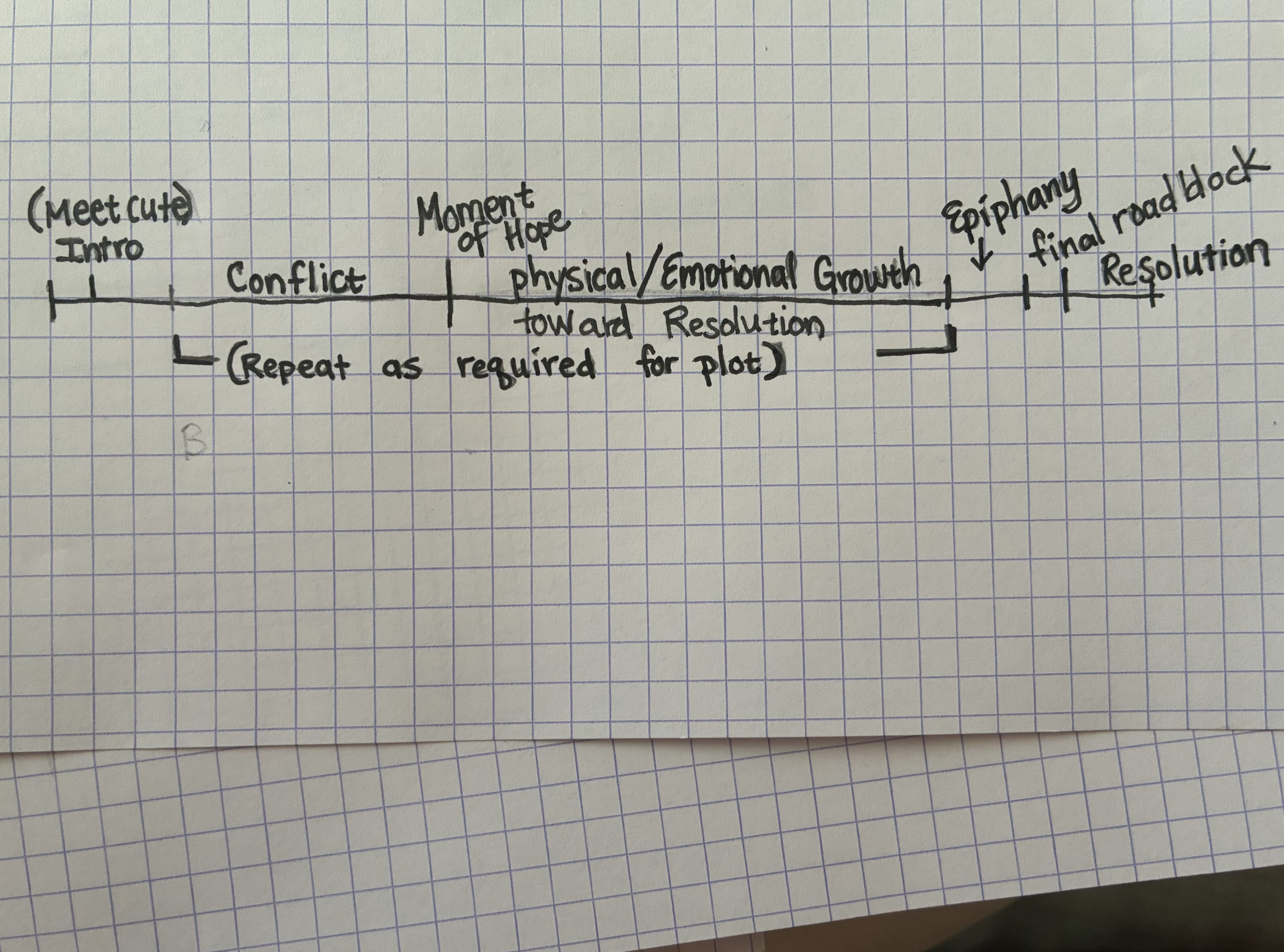
Above is the classic romance plot line drawn out in timeline form. Two characters meet, but regardless of how well it goes there needs to be conflict—either internal or external–to keep an emotional AND physical resolution from happening at the same time. This conflict usually leads to a Moment of Hope.
Example: Laura runs into Clive in an elevator and spills her coffee down his shirt. He thinks this is adorable, but she is mortified and flees on the wrong floor. Clive wishes he could have asked the mystery woman out but only dates within the office, certainly not at the rival firm on floor 3. There is an office party at a bar that night and Maureen, Laura’s best friend invites Clive (not knowing they had an earlier moment), and Clive agrees.
If the Moment of Hope is physical, we are usually talking about hand brushing or a big ole smooch. If there is anything steamier than that then the following conflict has to create a plausible physical or emotional wall that keeps them apart until the Epiphany moment.
Example: After some hijinks with a couple quirky sidekicks, Laura finds herself in the elevator with Clive again, some rude people jostle in and Laura ends up pressed up against Clive. They make prolonged eye contact as The Cranberries play over the elevator speakers.
After Moment of Hope is a period of physical or emotional growth that brings the characters together in whatever manner they are lacking. In our example, Clive will have to figure out Laura works with him, deal with the Maureen situation, and whatever B plot the author is throwing in. Laura will have to gain some confidence and quit overthinking stuff.
A note here: Depending on the length of your story, this is a rinse and repeat section. In tv series we might watch five or six seasons before love interests finally get together. In a short story each section might only be a brush stroke.
The Epiphany is the moment when one or both characters realize that they want to be on the same relationship page. This might lead to an immediate resolution, but often there is a final roadblock.
Example: Clive walks into the break room and sees Laura talking to Maureen about the party, he’s so surprised he trips and spills his coffee all over her. They lock eyes and smile. This could make a fine ending, or Maureen could be upset at losing her date, giving Laura an emotional barrier to overcome.
The final roadblock should have emotional weight. It should feel like a character is making a pivotal leap in personal growth. We know Laura has overthinking and confidence issues, so as a reader I want to see her say “Sure go to the party with Maureen and I’ll see you there. Maybe next week we can grab coffee and keep it off each other’s shirts?”
Now, in a traditional romcom Clive would do the choosing, leaving one of the women feeling sad, and probably resentful. Maureen would be a mean friend anyway, excusing the reader for rooting for the couple the author intends. But regardless, we end up with a resolution.
So:
Meet Cute
Conflict
Moment of Hope
Growth Arc
Epiphany
Final Roadblock
Resolution
Easy peasy right? Except it is a little more complex than that.
Attraction can be physical OR emotional. (There are a few others as well, but they fall broadly into those categories.) Resolution comes only when characters are BOTH in the same place physically AND emotionally. I have done my best to create a line graph that shows what one example of our timeline might look like when plotted out with all four attraction elements in play.
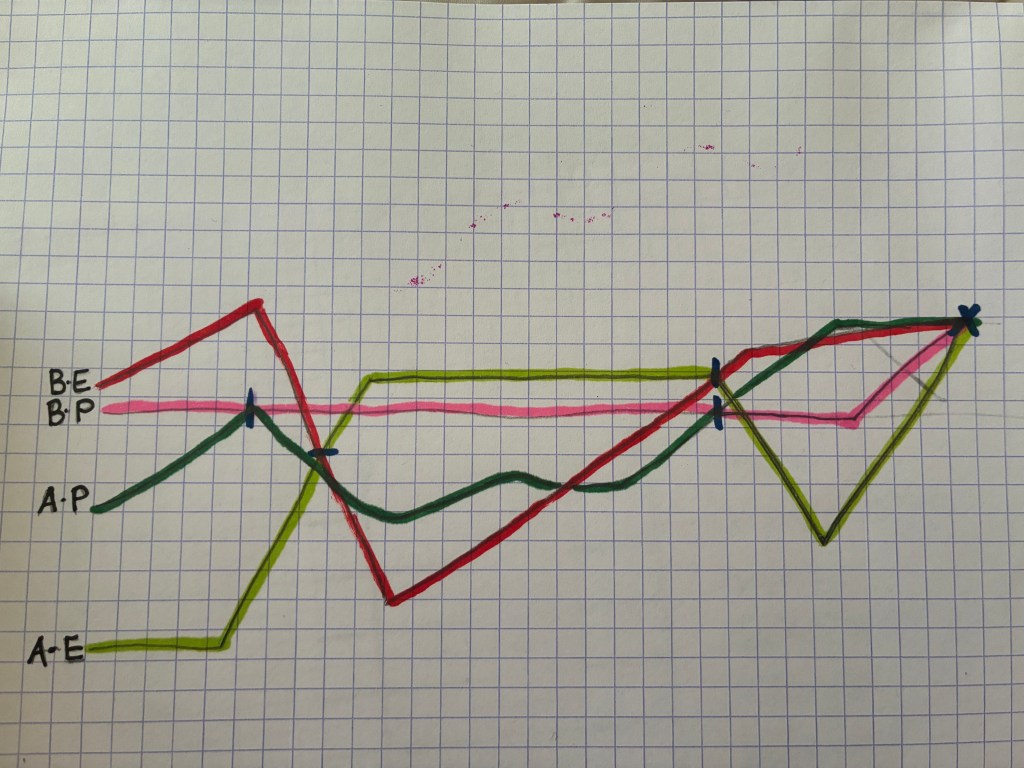
So what are we looking at? Two Characters, we’ll call them Adam and Bertie meet in the lobby of a restaurant they are both secretly reviewing. They used the same fake name and have been double booked and decided to share a table. Bertie is immediately physically attracted to Adam and finds him charming, more so as the evening progresses and they share a bottle of wine.
Adam on the other hand finds Bertie to be loud and a little too fawning, and thinks they are plain looking —but more attractive as the wine bottle empties. At the end of the night they have a sloppy make-out session where Adam calls Bertie by his ex’s name and starts crying.
Bertie still thinks Adam is hot, but wants nothing to do with the emotional mess. Adam on the other hand is smitten by the kind way Bertie handles his faux pas, even though when he sobers up he is back to finding them plain.
We need something to bring the two together again, so perhaps Bertie shows up at another restaurant and Adam is there as well, same issue with the double booking. Adam is emotionally interested, Bertie is physically interested but has great boundaries. They are competing for publication on restaurant reviews, but also love each other’s company as time goes by.
At some point we have the Epiphany moment: Adam and Bertie share a piece of tiramisu over candlelight and walk home arm in arm. They are made for each other, except! In the morning the final conflict is awaiting in Adam’s socials. Some pictures Adam took of the tiramisu have gone viral, with Bertie tagging him and accidentally outing him as a food critic. Adam is devastated, and out of a job.
Now Bertie, in love emotionally and physically has to make a grand gesture and fix his mistake which shows Adam just how right they are together. Maybe Adam really wants to start a food blog out in the open and Bertie uses Adam’s new clout to sets up a website and schedules a calendar full of comped meals at the best restaurants in the city. They both show up to the first one and Bertie has reserved a table for one a respectable distance away (boundaries and all).
Adam indeed sees the love in the gesture and the story ends with him inviting Bertie to share his table once again.
You can see on the line graph in dark blue where we have crossovers on the emotional and physical lines. When two lines meet, there should be an encounter of some kind. Notice also that the red and light green emotional lines begin moving dramatically at that first physical interaction crossover. A and B make out which triggers emotional movement.
Whatever the scene is when the red and light green emotional lines meet, it should reflect the change in the relationship dynamics for the reader and in this case set up the continued diversion of feelings.
The growth arc section needs to earn the epiphany moment (Which is an almost a blog post of it’s own) so that the reader feels a satisfactory change in the characters. Just spending time together isn’t enough.
The moment of Epiphany could be drawn with an X like at the end—for this story—since A and B are all in emotionally and physically at the same moment, BUT since we rip them apart just as quickly, for illustration purposes I left them spaced a little. Also notice that I kept the physical attraction high.
This flip side of this is to pull the characters apart physically, but keep them emotionally intact. So if Adam had been offered a job in Paris and Bertie had to stay in New York and take care of a parent, but they still love each other. I guess Adam could also be mauled by a bear and Bertie suddenly finds him horribly ugly and has to find the beauty in his scars? But that feels like a sequel rather than a final roadblock.
So We are going to wrap up with a look at a few more line graphs of common relationship trajectories. These all have both elements of attraction combined for simplicity’s sake.
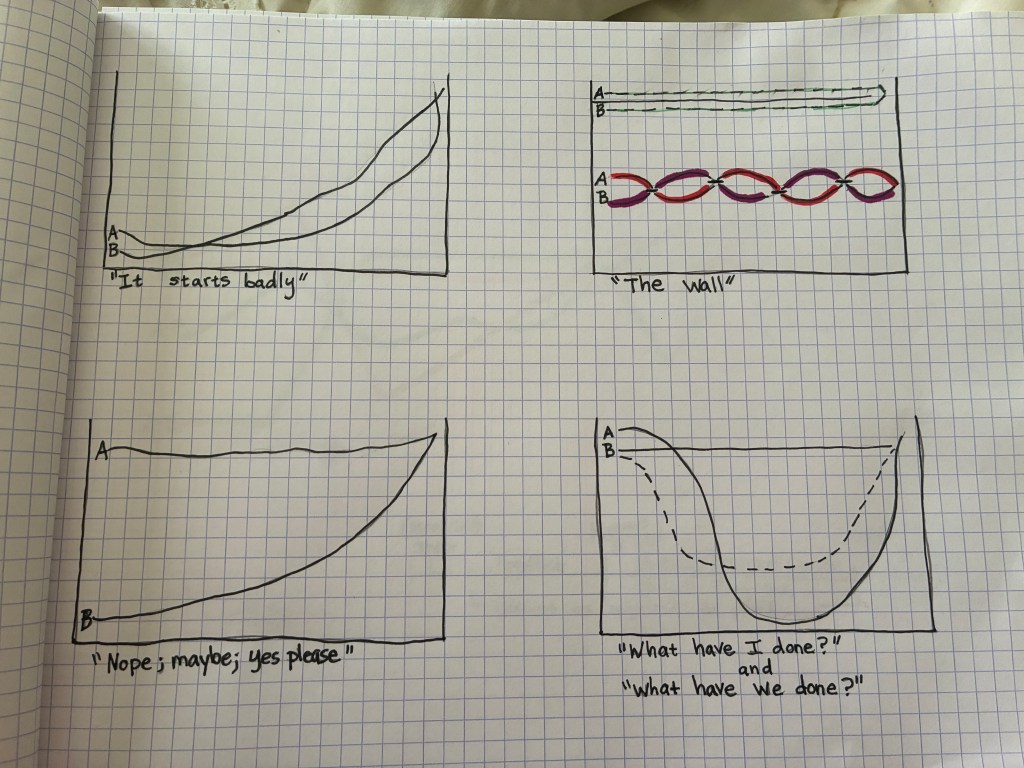
“It Starts Badly”: Carla and Norm are arch nemesis in the vending machine wars. When they have to combine their businesses to take out a rival snack baron, they find out how similar they are. We may see more crossover points with some “will they? Won’t they?” Action in the growth arc phase.
“The Wall”: Carla and Norm are madly in love but can only meet at the vending machines they both service at the college lest Norm’s controlling mother find out and call in a hit on Carla. When Norm finally stands up for Carla, mom has a heart attack and moves to Florida, leaving them to their love.
Or
Carla has been crushing on Norm for months until a new guy joins the vending team. Just as Norm realizes how cute Carla is, she goes on a date with Rusty. Rusty turns out to have a bad back and can’t lift chip boxes anymore; he takes a job in Maui making shaved ice. Heartbroken, Carla turns to Norm only to discover he has taken a vow of temporary orders to go learn the snack making ways of the local monks. Upon his return, and ready to finally take out Carla, he discovers she has been in a coma after a vending machine fell open and knocked her on the head. Norm sits by her bedside every day, telling of his adventures in snack making and how he loves her. She wakes to find him missing and about to marry a fallen snack nun (with a bun in the oven!) when she interrupts and lets him know she loves him too. (Snack nun goes on to run her own bakery and raises an emotionally healthy kid on her own.)
Caveat with this last version of the wall: It can get formulaic and boring pretty quickly. Writing characters with chemistry will help, but so often the “wall” character is so obviously not a serious contender for affection that the story loses tension.
“Nope; Maybe; Yes Please!” : Carla thinks Norm is super handsome. Norm isn’t interested in any way. Carla has enough Daddy issues to be addicted to getting uninterested men to fall in love with her. She begins a campaign and eventually wears Norm down.
To be fair, this is a major contender for most overused plot device ever and it’s usually wrapped up in a “oh isn’t it romantic that one of these characters is essentially stalking the other.” I would recommend taking a slightly different turn by giving the uninterested character a distraction like grief, addiction, hobbies, or a personality quirk that keeps them from realizing Character A’s obvious love.
Carla has been best buddies with Norm for years, but until his wife died she couldn’t do anything about her crush. As he processes his grief, Norm realizes that Carla may have a bigger part in his life going forward.
“What have I done?What have we done?”: Carla and Norm wake up married after a night in Atlantic City and are running from the mob. They are total strangers, or were enemies at work who won a trip, or maybe were friends until they woke up married.
There are two trajectories for this arc. Norm might actually like Carla and slowly win her over as they galavant around the city trying to get enough cash to pay off their mysterious mob debt. Or both could realize the mistake but still be stuck galavanting which obviously leads to their ultimate love resolution.
Now, I am going to point out the obvious here: Not every couple ends up together. There are plenty of resolutions that end up with a character dying, or the couple splitting up. When you add in a third person for romantic triangles, there are more options to suss out. The thing is, even if you kill off a character after the resolution, you need to first have a resolution for the death to have a bigger punch.
And that, my friends, is a lot of Overthinking Relationship Arcs.
A Writing Prompt for you this week: Use the timeline to plot out a relationship. Be as simple or as complex as you like, but try and get something for every category.
Meet Cute
Conflict
Moment of Hope
Growth Arc
Epiphany
Final Roadblock
Resolution
Happy Valentine’s Day!

 Mamasquatch the Writer
Leave a reply to sparklyperfectlyf982864c92 Cancel reply