
As fall unfurls her colors on the Upper Peninsula I am guzzling tea and spending more time in doors. My project basket currently holds half a crocheted halloween costume, and a stack of books on the Revolutionary War. This week I spent a lot of time in two of those books.
I finished up Campaigns of the Revolutionary War in Maps, though I have run into a small problem with some of the information. It seems that the writers of a certain tv show about spies during the Revolutionary War has already portrayed several of the more interesting characters with some liberty. While I’m not to the point of picking out minor characters for the upcoming book just yet, I do hesitate to have too much competing contemporary media. We shall see. Thankfully, I have a list of interesting characters NOT featured as well:
-“Baron” Johann de Kalb:
-Spanish Governor of Louisiana, Col Bernardo de Gálvez
-Lt. Col. Banastre Tarleton
-Maj. Henry Lee (only 23 in 1779!)
-Baroness Frederika von Riedesel
Benedict Arnold showed up again this week as well, in New London, Connecticut and he does not come away smelling rosy. I know that Yorktown is the hero of 1781 (Thanks Hamilton) but New London was a cascade of miscommunications and poor decision making that ruined lives and careers on both sides.
Though I’ve turned the last page on Campaigns, I’m keeping it near at hand as a reference. In the meantime I also started The Women of The American Revolution, vol 1, by Elizabeth Fries Lummis Ellet and published originally in 1848.
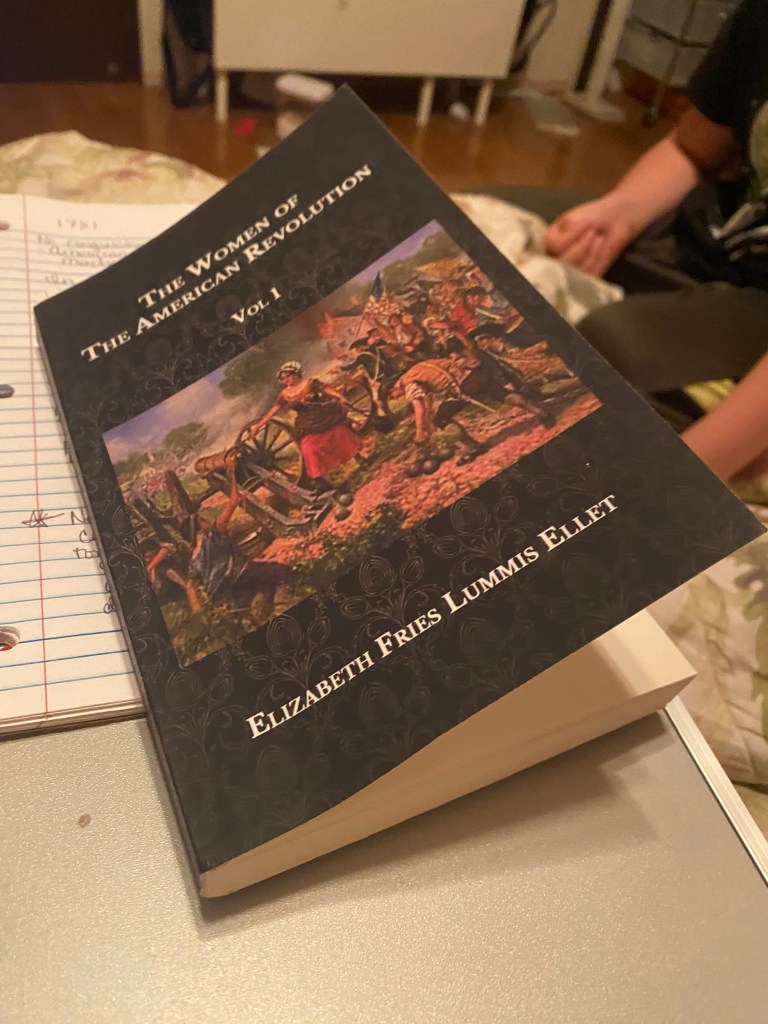
Sometimes books written more than a hundred years ago are historically invaluable for their intended purpose. Thus far this is not the case with Ms. Lummis Ellet’s work. The author is a fangirl. Of Mary Washington (George’s mother) she writes “The Mother of Washington! There needs no eulogy to awaken the associations which cling around that sacred name. Our hearts do willing homage to the venerated parent of the chief…”(16)
Nine pages of the same later, all I learned was that Mrs. Washington was described as being of medium height with “strongly marked” features. She lost her husband relatively early, was devoted to the poor, and her famous son was rather devoted to her. The subsequent chapter is as far as I have reached as of yet, and my hopes aren’t high friends.
The bits of helpful info I have found have been in the excerpts of letters in the book’s introduction. They detail the state of the colonies during the early part of the war, and absent the author’s commentary offer a frank description of every day life for the women residing in Philadelphia. Well to do women had given up tea, and taken up their knitting needles. Spinning, and weaving their own cloth would have certainly had an impact on millineries at the time.
What I do find fascinating about my current read is what the ardent tone says about the culture of America at the time it was written. A dozen years before the first shots of the Civil War, there is almost a deification of the founding fathers, and already a skewing of the facts when it came to their religious beliefs. Of course there is no chapter detailing the contributions of any enslaved or Indigenous women.
I’m going to keep skimming the book. With online archives, all I need are names and a few details to search and—often— find scans of letters and documents that are of course not cited (no end notes at all). I also think it’s pretty neat that in 1848, when women had a small enough place in the publishing world that Elizabeth Fries Lummis Ellet took the time to compile a history of women’s contributions in the war. Good on her!
Just as I was sitting down to write this, I got sucked into a giant research vortex disguised as a rabbit hole. There are three tabs open on my computer already and folks, I am excited!
Spoiler Alert for next week: Prison Ships!


 Mamasquatch the Writer
Leave a reply to sparklyperfectlyf982864c92 Cancel reply