Let me overthink this through…

I’ve never met an idea I couldn’t overthink. Thank my glorious neuro-spicy brain, generational anxiety, or the well developed imagination that keeps me churning out thoughts day and night. Welcome to a peek inside my head.
Overthinkings: Writing Romantic Moments
You can only break things down into so many graphs before you have to actually put words on the page. The consensus of my writing group is that writing romance is difficult. Maybe the most difficult? When I dug a little deeper the reasons for this difficulty seemed to break down into a couple of categories.finding the right balance of romance for the intended audience, and pacing the romantic moments.
The truth is, there aren’t hard and fast categories in the romance genre, and things get more complicated when we are talking about romantic moments in general fiction and genre work. But generally, if a romantic relationship arc is the primary storyline, or a prominent secondary storyline where the emotional growth arc of a romantic relationship is explored then a book is going to be considered “romance”. If your story has a non-romantic central plot with a secondary romantic plot then it is going to be a Sci-fi romance, or a Mystery romance, etc. If your story has a central plot and secondary plot that are not romantic in nature, but the protagonist is dating or in a relationship where romantic scenes happen on the page then it would likely be considered general fiction or genre fiction.
As to how much physical action is going to play out on the page, that also depends a lot on the story you are telling and what category it sits in.
Nobody be smooching all heavy in a kid lit book, thanks. Young Adult romance is a huge market right now but the focus tends to run more to the emotional side of things. It is likely to fall on the physical scale near Christian Romance and lighter general fiction: kissing, anticipation, then a fade to black moment.
General fiction on the spicier side is going to run steamier and more explicit, descriptions of sexual acts but generally within the context of a character arc or plot interaction. Makes sense within the storyline and traditional relationship trajectory. This last part is key. I’m not saying that there isn’t gratuitous sex in general fiction, but readers are going to expect it to make sense within the plot. If they wanted explicit with no plot they would be looking in a different section of the library.
Romance novels have been around about as long as novels. Formulaic structuring with sex scenes regularly spaced into the plot. The romance/storyline is central and focuses on the emotional journey of the characters. The reader gets a happy ending. The other plot elements are less consequential, as readers are looking for tropes. This genre is also the most read/purchased so plenty of people are seeking this content. Also easiest genre to get published in, especially if there is any substance at all.
Genre romance: Historical romance, space romance, ghost romance…these books tend to have more substance and world building than generic romance. They can also get weird.
Smut: smut in this usage is not considered a derogatory term. Instead it is a category of romance where the explicit sex scenes are prioritized over emotional arcs. Reddit sets the line at “are genitals being named; are sex acts described in detail?” Plot is negotiable.
My recommendation for writing anything is to just go in and write that first draft. It can be as awful or glorious as you like. Plot? Hopefully, but sometimes that comes together in a later draft. First drafts are for dumping out the brain bucket and seeing how it sticks together. But once you have a semblance of events, then it is time to pace them out and see what you have.
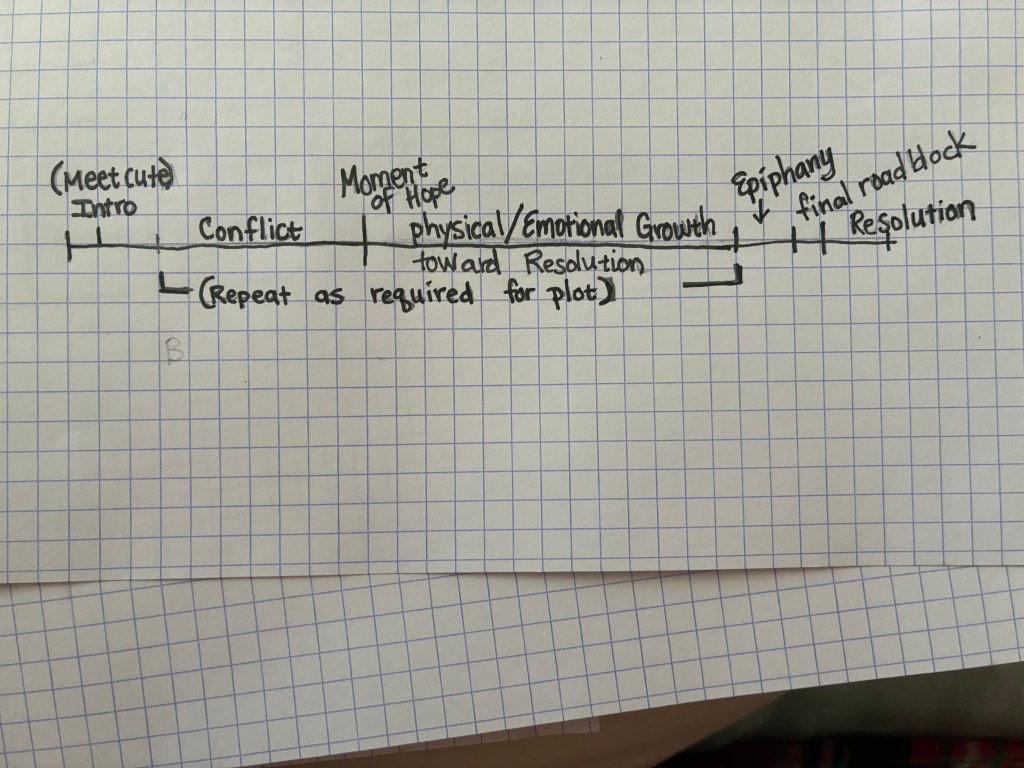
Just a quick throwback here to last week, below is a picture of our relationship trajectory. We don’t have to follow it exactly, but keeping it in mind should help with pacing.
So now that we have a diagram and some definitions, how do we write a romantic interaction? As this is a PG rated website, we will go with your standard lead up-interaction-pull away scene.
First-Set the scene. We need enough detail to understand where the choreography is happening so that if Edwin rests his hand on a planter half-way through we aren’t asking” wait where are they that there are planters?”
Edwin led Seraphina along the cobbled path toward the greenhouse. Clouds scuttled across the half moon as raindrops began to find their way onto the fabric of her white linen sundress; Seraphina’s shoe caught between the slate pavers.
So we know that it is night, there is limited light, our girl is about to go wet teeshirt contest on us and suddenly she is in mild distress. Now, there are some little changes we can make to set up the romance to come.
Edwin led Seraphina along the cobbled path toward the secluded greenhouse. Angry clouds scuttled across the half moon as raindrops began to find their way onto the fabric of her white linen sundress; the slate pavers caught Seraphina’s high heel with their jagged teeth.
Sultry clouds scuttled across the half moon as raindrops slipped through the fabric of her white linen sundress; the slate pavers clutched at Seraphina’s sandal. She grasped Edwin’s arm playfully as he bent to free the shoe.
Use Adverbs and adjectives to set the tone you want. Do we want a playful and flirty couple sneaking away from a party or a nervous couple hurrying away from an awkward scene at dinner?
After we set the tone, it is time to raise the tension. We are going to do this by some initial contact, dialogue, and then a roadblock.
As Edwin’s fingers brushed her ankle, Seraphina shivered at his calluses.His hands were broad from years of labor and he might have crushed her delicate bones if the desire struck him.
“You must work so hard to have such a strong grip,” She murmured.
“I do a lot of manual labor.” Edwin freed her shoe but let his hands linger on her ankle for another heartbeat. He stood, shaking off the rain caught in his copper curls.
Seraphina raised her hand to brush a stray drop from his cheek but Edwin caught it and placed it against his heart instead. “Phi, say you’ll kiss me or let me drown here lest I have to live a life empty of your love!”
“Oh Edwin!” Seraphina flushed prettily, standing on her toes, she meant to fulfill his every desire.
CRACK! A bolt of lightening hit the tree next to the greenhouse. Seraphina leapt forward just as Edwin leaned toward her and felt the crunch of his nose against her forehead.
If this is the beginning of a book this could be a great meet-cute gone wrong; this scene as is could be a Moment of Hope and now we are going to pull back and have some distance to work back from. For my purposes this is the final roadblock after we have read two hundred pages of will they won’t they, Seraphina being engaged to a wealthy jerk who happened to be Edwin’s best friend, and now they are running away from the engagement party only to find themselves near death with Edwin bleeding.
“Oh Edwin, maybe it’s a sign?” Seraphina wiped the blood from her forehead. She leaned over to tear a swath from her dress and pressed it to his face.
Edwin flinched at her touch, though it could have been the pain of someone shoving a wad of cloth into his broken nose. “It’s only a sign that we should duck into that greenhouse.”
The two hurried through the iron archway into the old building. Ivy climbed one wall and a few empty potting tables stood like guards against the others. A stone bench, overgrown with moss beckoned to Seraphina. She collapsed, tears replacing the raindrops on her face.
“If only Rupert wasn’t so cruel and only marrying me for father’s race horses! If only you weren’t so kind and manly and good at croquet! Why couldn’t you have been born the son of an earl instead of being a lowly soldier? Oh Edwin, why must the world be so unfair?”
Edwin joined Seraphina on the bench. “So you won’t run away with me after all? Because I’m not rich?”
Serpahina gasped, “That wasn’t what I meant at all! Of course I’m running away with you Edwin! Even if we have to live in a van as we tour the professional croquet circuit! It’s only that I might complain once in a while about all I’m leaving behind.” With that she kissed him, not even minding the blood that mingled with her tears.
Edwin kissed her back, pulling back just enough to wipe the snot from her upper lip—for Seraphina was a very messy crier—before finding her lips with his own once more.
Later, when all was said and done and the two lay on a potting table staring up at the stars that had emerged, Edwin whispered into Seraphina’s hair “Who told you I wasn’t an Earl?”
The trick with writing romance is that the tension is built on two different strains. We have an emotional plot arc and a physical plot arc. You can have physical moments of hope and emotional moments of hope, same with conflicts, epiphanies, roadblocks, etc. Many books will have resolution moments throughout, but never both strains resolving until the end.
The goal is to keep the reader engaged throughout the relationship journey. If Edwin and Seraphina had the same conflict over and over it would get boring really quickly (sure it would be weird to have several lightening storm moments, but substitute it for Seraphina being jealous or Edwin running away to a croquet tournament every time they argued. The third or thirtieth time and the reader is skimming.)
So how do we come up with interesting ways of prolonging the tension? Base everything in character work: skills, abilities, desire, kink, trauma, motivations, every thing should be rooted in the character. Things feel plausible if they are consistent with the character’s past behaviors and actions, and the backstory they have given us on the page.
Now when we finally do reach that moment of emotional and physical resolution it is going to require a nice balance of physical description, dialogue, internal dialogue, and setting. How much of each is up to you as the writer. Keep in mind that the more explicit you are, the less imagination a reader has to use, and therefore—after a point— the more narrow your audience becomes.
When I claimed during writing group that writing sex scenes is like choreographing fight scenes I was mocked for a full two minutes, but I stand by it! Balance action and dialogue; let us know ahead of time about any props that are going to show up; don’t let it drag on too long; when in doubt skip forward to the aftermath.
Writing romance is as much an art and science as any other genre, and the readers are loyal and forgiving.
Happy February everyone! I’ll let you make up your own writing exercise this week as I somehow scheduled our annual Broadway in the Basement fundraiser (which I am catering) for the first weekend of Girl Scout Cookie Booths. I’ll see you back here in March!
Overthinkings: Character Psychologist, Love Languages
Back in the nineties someone gave me a copy of The Five Love Languages, by Gary Chapman. The idea is that everyone gives and receives love—primarily—in one of five ways and if you can just figure out what your language is, and what your partner’s is, then you’ll never have trouble showing each other love again!
Okay, maybe that wasn’t the author’s intended message, but it was the popular takeaway from conservative evangelical readings in my world at the time.
So what are these five languages? Well, to have any Bible camp creds you had to be able to rattle off at least four. Physical touch, words of affirmation, Gifts, quality time, and Acts of service. (Still got it!) The Five Love Languages may not be a standout in the pseudo social science world, but the author wasn’t totally off base. People do value different components of relationships differently, and they often unconsciously show affection of the type they enjoy receiving themselves.
I imagine by this point you are asking “what does this have to do with writing? Are you suggesting that we should take into consideration how a character gives and receives love when crafting a romantic arc?”
Um, yes. Thanks for jumping the gun there and stealing my thunder. But also, let me explain why I think this could be a valuable exercise.
One of the biggest cliche’s out there is when two characters have a misunderstanding that could be cleared up with a simple conversation. What I want to see on the page is deeply rooted tension stemming from long running miscommunication. A great way to achieve this is for two characters not to understand that the other is showing love in their own way.
Let’s take a look at how we might use each of the Love Languages to create some tasty tension.
Physical touch: Every nineties Bible Camp Guy claimed that physical touch was their love language. I am making this a universal statement based on my own experience but I’ll wager a shiny penny that I won’t get any counter arguments. Now I haven’t read the book in twenty five years but I remember the author putting some sort of caveat in the chapter that most everyone with functioning nerve ends likes some sort of physical touch. I don’t know exactly where the line between normal dopamine release and “I feel loved because you are skritching my head” falls, but for the sake of the article let’s pretend it exists.
For some people, physical intimacy is their way of saying I love you, I’m thinking about you, I care you exist. For some other people a handshake is too much contact. (Then there are those of us with sensory issues who can go from sitting on your lap to “nobody come within ten feet of me” in the blink of an overstimulated eye). Putting any combination of these folks in a relationship is going to test everyone’s boundaries.
This is a great element to throw into a character with boundary or communication issues. It could be a great catalyst for their personal growth arc if you have repeated instances where the character is feeling uncomfortable. If you want to set up the Cuddly character as problematic, you can have them guilt or shame their partner for their coldness or push at those boundaries purposefully.
For a more benevolent Cuddler, have the partner leave their feelings unspoken. It is a fine line before the reader starts judging and laying blame, especially since—in Washington State at least— 1 in 8 adults will experience partner violence of some sort.
The next four Love Languages are less tricky to balance.
Words of Affirmation can be a huge deal to characters seeking approval. Everyone loves hearing how great they are or how much they are appreciated, though maybe less so for those of us who grew up heaped with praise. For the Words of Affirmation lover, actions speak nothing without words to back them up.
A character who seeks out words of affirmation runs the risk of appearing needy to the readers. Nobody likes a pick-me girl—unless the character is supposed to be a pick-me girl. If you are trying to avoid this, have the character respond to unbidden praise or acknowledgment with very specific physical descriptions.
“Thank you so much for grabbing my kitten out of traffic mister! You sure are brave!” The little girl cried, hugging the reluctant animal to her chest as she swung from side to side.
Lars flushed at the praise, his heart still pounding from the frantic dash. With a final nod to the girl’s mother he turned and walked, a little taller, away.
A Words character can be paired well with a Non Words character for very effective miscommunication. While some of the other love languages might be harder to read on the page, having one character screaming “You never say you love me!” To their partner, who admittedly never says it out loud but has spent the last five chapters showering them in gifts, or waiting on them hand and foot feels relatable—neither party is wrong, they just aren’t speaking the same language.
Quality time is traditionally explained as well, spending time with someone where the focus is pleasant. Angry roadtrips with screaming kids might put two characters in the same car but it would not be considered quality time. Quality time characters may come across as emotionally needy, and taken to an extreme, two of these folks in a relationship might look emotionally co-dependent.
While it is’nt in the description, I think there is something to the idea of Quality time also including offering a partner the time they need to do things they enjoy by themselves. Or maybe that would be considered a Gift. I’m not rereading the boo again.
Gifts happens to be the way I show love, especially handmade gifts. My brain naturally tucks away random facts about my friends and family…and random strangers; all year I make or buy little things that I know will make my people happy. It brings me a lot of joy.
Now, could this be misconstrued as Love Bombing? Sure, if you’re heartless. Although using a character’s love of Gifts as a character flaw or a base for a love bombing plot arc is a grand idea. I’ve seen some story lines where a desire to give gifts leads to debt and conflict as well.
Acts of service is my receiving love language—specifically bringing me tea. You want to woo this lady? Set a steaming mug next to me and my heart will grow three sizes. Acts of Service may look like a character doing extra work around the house, picking up a friend’s kids, or bringing meals to a sick neighbor. Think of them as thoughtful deeds that makes someone’s life a little warmer.
Or is that character a doormat? Servile and fawning? Are they trying to keep in someone else’s good graces? I think you can write the story however you like, but if you want a reader to like the Acts of Service-server their deeds should be done out of benevolence and likely be paired with at least some backbone. If the recipient of the Acts is not grateful they will automatically be construed in a negative light.
So why is all of this useful—other than the handful of writing ideas I threw in there?
We can never know our characters too well. Feeling loved is a fundamental factor in a human’s response to others. Growing up and beyond we often use other’s responses and behaviors as a mirror; if we are loved then we believe we deserve love. Look at “bad” people out in the world and almost invariably there was a lack of love that shaped that person’s behavior. Now, I am not universally blaming parents for their kids issues. That lack of love could have come from parents, peers, systematic “isms”, romantic partners, teachers or authority figures, structured religions, etc.
On the flip side, well adjusted people tend to have strong familial and community ties—or they’ve gone through a lot of therapy. The more a character likes themselves, the less they are going to be seeking out external sources of love. The groveler, the pick-me girl, the narcissist, the manipulator should have a dearth of love in their backgrounds that have caused this personality flaw.
A common issue is writing problematic relationships is when the antagonist is a villain who has no pattern to their behavior. Have that antagonistic character utilize another’s love languages to love bomb or manipulate is a great way to give their behavior a shape and logic.
In this same vein, even acts that are highly inappropriate or offensive can be rooted in motivations that the perpetrator perceive as love. The misperception may be from a cultural blindness, generational, or stemming from normalization in childhood. If love, however misguided, is at the root of something, it makes it feel more forgivable? Or at least relatable.
Stepping back over to the less problematic relationships. Knowing a character’s love language can help with writing a cohesive character. If Clara is feeling overwhelmed by her life and the mental load of being a full time private eye, PTA vice president, and mom of three, she is going to respond very differently if her partner buys her a box of chocolates vs. hires a housekeeper (who ends up being a spy).
If George craves the affirmation he never got from his mother and is confronted with two romantic partner options is he more likely to go for a. The strong silent guy who ignores him but leaves chocolates on his desk? Or b. Larry who gets his bagel order wrong every day but always compliments George’s snazzy ties and tells him how smart he is? Okay 50/50, but the reader is going to be rooting for Larry because we know he’s the right option.
Love languages are a pseudo social science in the vein of the Meyer’s Briggs test and magazine horoscopes. They are broad enough to feel plausible, and more importantly are fun to talk about. As we are heading into the back side of February I hope you take time to celebrate love where you can.
Writing Exercise: Write an interaction with two characters (keeping their love languages in mind), then write the same interaction but give each character a different set of love languages. Repeat as many times as you’d like.
Overthinkings: Relationship Arcs
As someone who loves puzzles, I enjoy breaking just about anything down into visual organizers. Venn diagrams are my favorite— secondsies goes to the good old timeline— but a line graph is probably the most universally useful in showing changes over time.
Writing relationship arcs isn’t exactly a science, but there are commonly used formulas involved and they look great in line graph form. This week we are going to look at some visual diagrams that show how an author might use some of last week’s tropes to plot out their character’s romance trajectories.
Relationships on the page don’t necessarily reflect reality. Especially if an author is jumping in in the middle of the story and showing flashbacks! That said, an author needs to know the story from the beginning to the resolution to keep their story cohesive. Now, after all that gushing about line graphs one might think that’s where I’m going to start, but let’s sit back and look at a timeline for a moment.
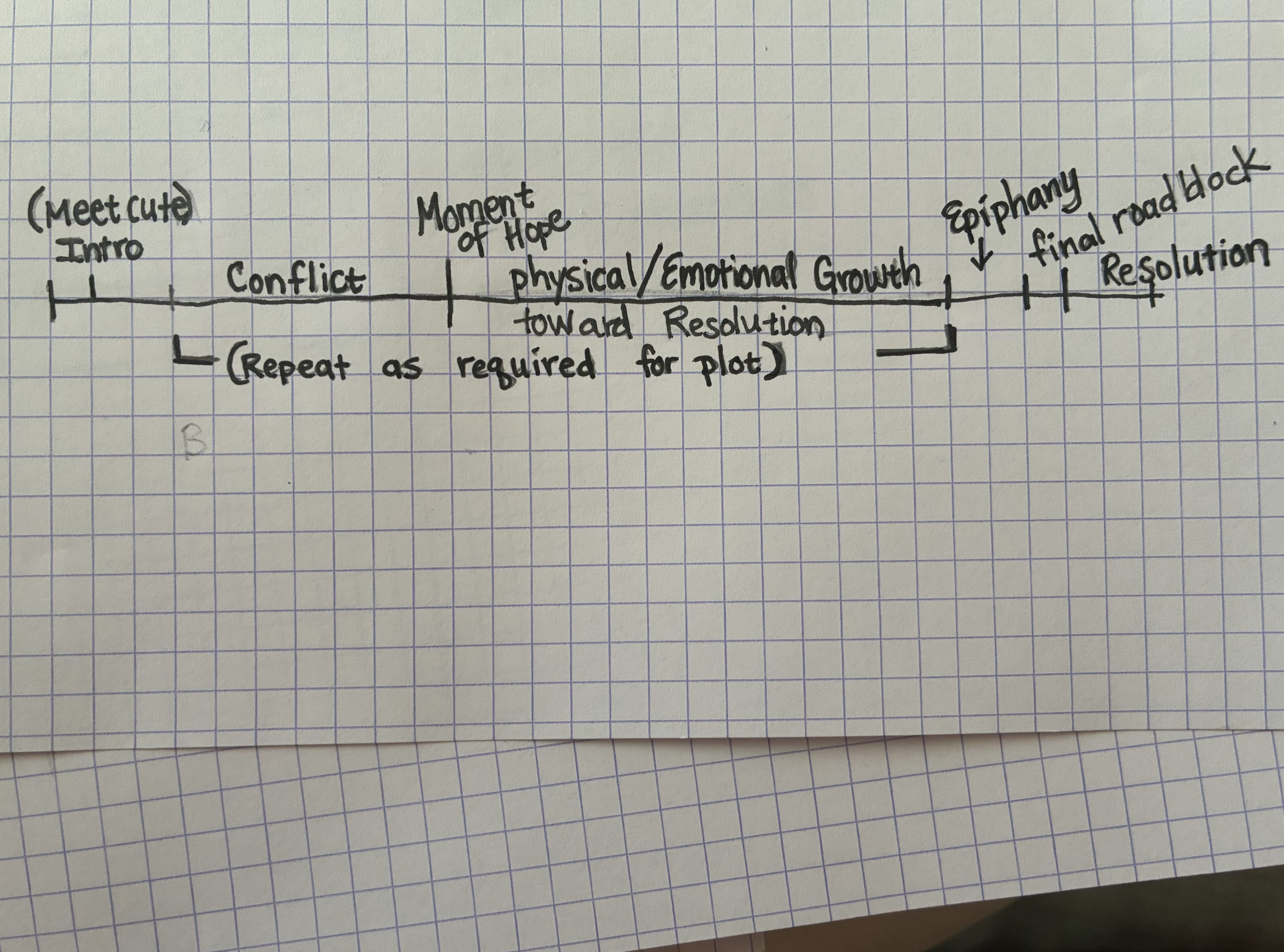
Above is the classic romance plot line drawn out in timeline form. Two characters meet, but regardless of how well it goes there needs to be conflict—either internal or external–to keep an emotional AND physical resolution from happening at the same time. This conflict usually leads to a Moment of Hope.
Example: Laura runs into Clive in an elevator and spills her coffee down his shirt. He thinks this is adorable, but she is mortified and flees on the wrong floor. Clive wishes he could have asked the mystery woman out but only dates within the office, certainly not at the rival firm on floor 3. There is an office party at a bar that night and Maureen, Laura’s best friend invites Clive (not knowing they had an earlier moment), and Clive agrees.
If the Moment of Hope is physical, we are usually talking about hand brushing or a big ole smooch. If there is anything steamier than that then the following conflict has to create a plausible physical or emotional wall that keeps them apart until the Epiphany moment.
Example: After some hijinks with a couple quirky sidekicks, Laura finds herself in the elevator with Clive again, some rude people jostle in and Laura ends up pressed up against Clive. They make prolonged eye contact as The Cranberries play over the elevator speakers.
After Moment of Hope is a period of physical or emotional growth that brings the characters together in whatever manner they are lacking. In our example, Clive will have to figure out Laura works with him, deal with the Maureen situation, and whatever B plot the author is throwing in. Laura will have to gain some confidence and quit overthinking stuff.
A note here: Depending on the length of your story, this is a rinse and repeat section. In tv series we might watch five or six seasons before love interests finally get together. In a short story each section might only be a brush stroke.
The Epiphany is the moment when one or both characters realize that they want to be on the same relationship page. This might lead to an immediate resolution, but often there is a final roadblock.
Example: Clive walks into the break room and sees Laura talking to Maureen about the party, he’s so surprised he trips and spills his coffee all over her. They lock eyes and smile. This could make a fine ending, or Maureen could be upset at losing her date, giving Laura an emotional barrier to overcome.
The final roadblock should have emotional weight. It should feel like a character is making a pivotal leap in personal growth. We know Laura has overthinking and confidence issues, so as a reader I want to see her say “Sure go to the party with Maureen and I’ll see you there. Maybe next week we can grab coffee and keep it off each other’s shirts?”
Now, in a traditional romcom Clive would do the choosing, leaving one of the women feeling sad, and probably resentful. Maureen would be a mean friend anyway, excusing the reader for rooting for the couple the author intends. But regardless, we end up with a resolution.
So:
Meet Cute
Conflict
Moment of Hope
Growth Arc
Epiphany
Final Roadblock
Resolution
Easy peasy right? Except it is a little more complex than that.
Attraction can be physical OR emotional. (There are a few others as well, but they fall broadly into those categories.) Resolution comes only when characters are BOTH in the same place physically AND emotionally. I have done my best to create a line graph that shows what one example of our timeline might look like when plotted out with all four attraction elements in play.
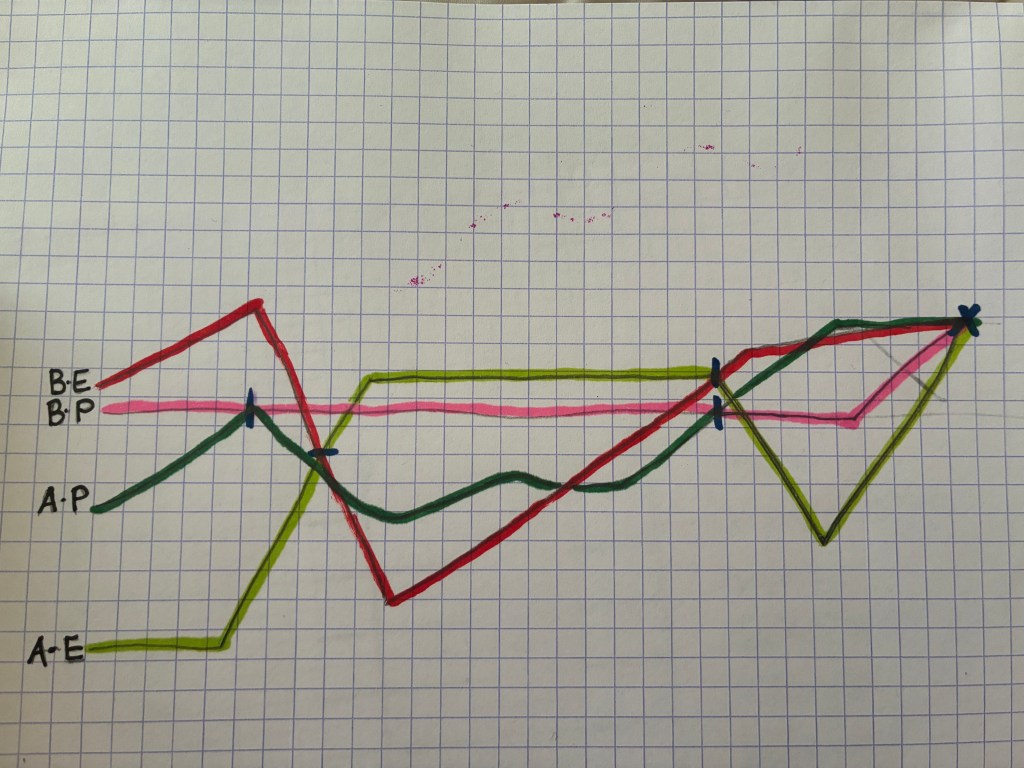
So what are we looking at? Two Characters, we’ll call them Adam and Bertie meet in the lobby of a restaurant they are both secretly reviewing. They used the same fake name and have been double booked and decided to share a table. Bertie is immediately physically attracted to Adam and finds him charming, more so as the evening progresses and they share a bottle of wine.
Adam on the other hand finds Bertie to be loud and a little too fawning, and thinks they are plain looking —but more attractive as the wine bottle empties. At the end of the night they have a sloppy make-out session where Adam calls Bertie by his ex’s name and starts crying.
Bertie still thinks Adam is hot, but wants nothing to do with the emotional mess. Adam on the other hand is smitten by the kind way Bertie handles his faux pas, even though when he sobers up he is back to finding them plain.
We need something to bring the two together again, so perhaps Bertie shows up at another restaurant and Adam is there as well, same issue with the double booking. Adam is emotionally interested, Bertie is physically interested but has great boundaries. They are competing for publication on restaurant reviews, but also love each other’s company as time goes by.
At some point we have the Epiphany moment: Adam and Bertie share a piece of tiramisu over candlelight and walk home arm in arm. They are made for each other, except! In the morning the final conflict is awaiting in Adam’s socials. Some pictures Adam took of the tiramisu have gone viral, with Bertie tagging him and accidentally outing him as a food critic. Adam is devastated, and out of a job.
Now Bertie, in love emotionally and physically has to make a grand gesture and fix his mistake which shows Adam just how right they are together. Maybe Adam really wants to start a food blog out in the open and Bertie uses Adam’s new clout to sets up a website and schedules a calendar full of comped meals at the best restaurants in the city. They both show up to the first one and Bertie has reserved a table for one a respectable distance away (boundaries and all).
Adam indeed sees the love in the gesture and the story ends with him inviting Bertie to share his table once again.
You can see on the line graph in dark blue where we have crossovers on the emotional and physical lines. When two lines meet, there should be an encounter of some kind. Notice also that the red and light green emotional lines begin moving dramatically at that first physical interaction crossover. A and B make out which triggers emotional movement.
Whatever the scene is when the red and light green emotional lines meet, it should reflect the change in the relationship dynamics for the reader and in this case set up the continued diversion of feelings.
The growth arc section needs to earn the epiphany moment (Which is an almost a blog post of it’s own) so that the reader feels a satisfactory change in the characters. Just spending time together isn’t enough.
The moment of Epiphany could be drawn with an X like at the end—for this story—since A and B are all in emotionally and physically at the same moment, BUT since we rip them apart just as quickly, for illustration purposes I left them spaced a little. Also notice that I kept the physical attraction high.
This flip side of this is to pull the characters apart physically, but keep them emotionally intact. So if Adam had been offered a job in Paris and Bertie had to stay in New York and take care of a parent, but they still love each other. I guess Adam could also be mauled by a bear and Bertie suddenly finds him horribly ugly and has to find the beauty in his scars? But that feels like a sequel rather than a final roadblock.
So We are going to wrap up with a look at a few more line graphs of common relationship trajectories. These all have both elements of attraction combined for simplicity’s sake.
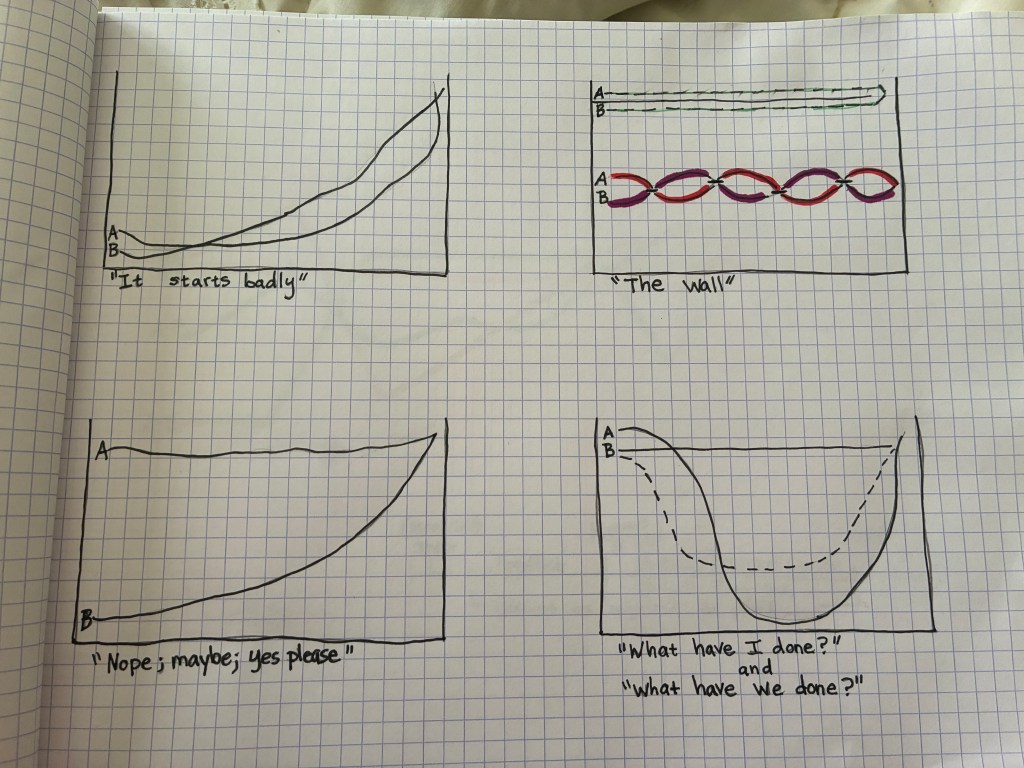
“It Starts Badly”: Carla and Norm are arch nemesis in the vending machine wars. When they have to combine their businesses to take out a rival snack baron, they find out how similar they are. We may see more crossover points with some “will they? Won’t they?” Action in the growth arc phase.
“The Wall”: Carla and Norm are madly in love but can only meet at the vending machines they both service at the college lest Norm’s controlling mother find out and call in a hit on Carla. When Norm finally stands up for Carla, mom has a heart attack and moves to Florida, leaving them to their love.
Or
Carla has been crushing on Norm for months until a new guy joins the vending team. Just as Norm realizes how cute Carla is, she goes on a date with Rusty. Rusty turns out to have a bad back and can’t lift chip boxes anymore; he takes a job in Maui making shaved ice. Heartbroken, Carla turns to Norm only to discover he has taken a vow of temporary orders to go learn the snack making ways of the local monks. Upon his return, and ready to finally take out Carla, he discovers she has been in a coma after a vending machine fell open and knocked her on the head. Norm sits by her bedside every day, telling of his adventures in snack making and how he loves her. She wakes to find him missing and about to marry a fallen snack nun (with a bun in the oven!) when she interrupts and lets him know she loves him too. (Snack nun goes on to run her own bakery and raises an emotionally healthy kid on her own.)
Caveat with this last version of the wall: It can get formulaic and boring pretty quickly. Writing characters with chemistry will help, but so often the “wall” character is so obviously not a serious contender for affection that the story loses tension.
“Nope; Maybe; Yes Please!” : Carla thinks Norm is super handsome. Norm isn’t interested in any way. Carla has enough Daddy issues to be addicted to getting uninterested men to fall in love with her. She begins a campaign and eventually wears Norm down.
To be fair, this is a major contender for most overused plot device ever and it’s usually wrapped up in a “oh isn’t it romantic that one of these characters is essentially stalking the other.” I would recommend taking a slightly different turn by giving the uninterested character a distraction like grief, addiction, hobbies, or a personality quirk that keeps them from realizing Character A’s obvious love.
Carla has been best buddies with Norm for years, but until his wife died she couldn’t do anything about her crush. As he processes his grief, Norm realizes that Carla may have a bigger part in his life going forward.
“What have I done?What have we done?”: Carla and Norm wake up married after a night in Atlantic City and are running from the mob. They are total strangers, or were enemies at work who won a trip, or maybe were friends until they woke up married.
There are two trajectories for this arc. Norm might actually like Carla and slowly win her over as they galavant around the city trying to get enough cash to pay off their mysterious mob debt. Or both could realize the mistake but still be stuck galavanting which obviously leads to their ultimate love resolution.
Now, I am going to point out the obvious here: Not every couple ends up together. There are plenty of resolutions that end up with a character dying, or the couple splitting up. When you add in a third person for romantic triangles, there are more options to suss out. The thing is, even if you kill off a character after the resolution, you need to first have a resolution for the death to have a bigger punch.
And that, my friends, is a lot of Overthinking Relationship Arcs.
A Writing Prompt for you this week: Use the timeline to plot out a relationship. Be as simple or as complex as you like, but try and get something for every category.
Meet Cute
Conflict
Moment of Hope
Growth Arc
Epiphany
Final Roadblock
Resolution
Happy Valentine’s Day!
Something went wrong. Please refresh the page and/or try again.
 Mamasquatch the Writer