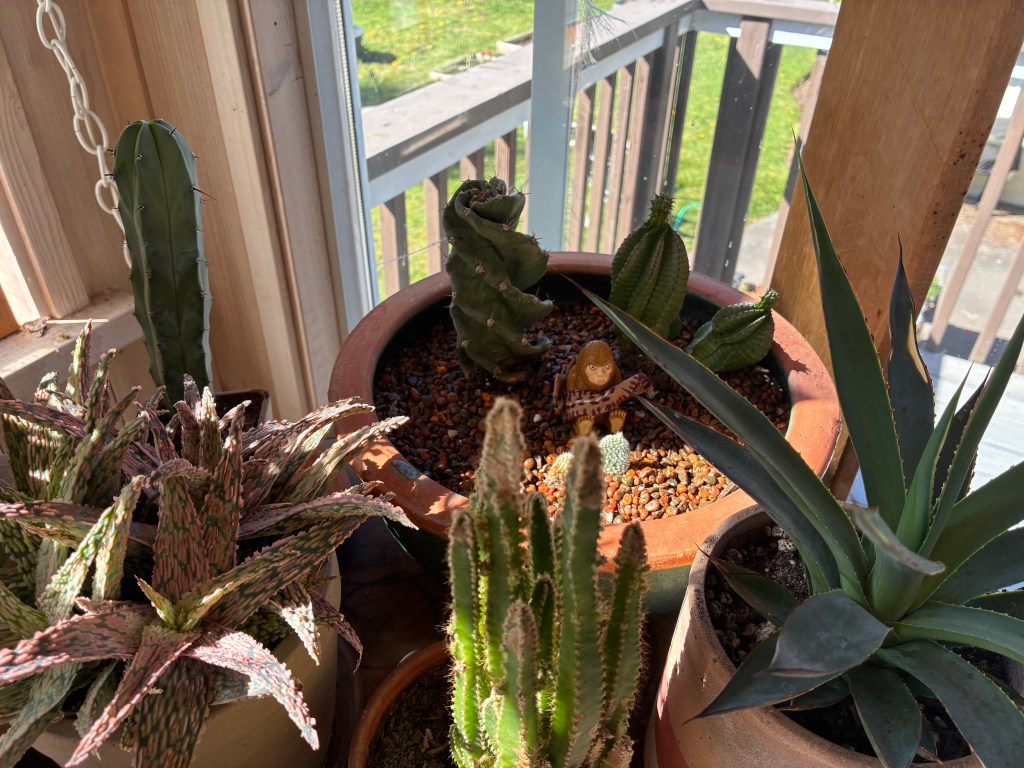
The sun is shining here in Sequim for the fifth day this week! Grass is growing, trees are budding, and my cosmos seedlings are staring to peek out of the dirt in their egg cartons. Everything is turning green; it would be a terrible place to set a gothic horror novel. Spring is often used as a metaphor for new beginnings in literature. The characters have made it through the harsh winter and now get to resume their adventuring.
Spring is a great time to start new projects. Sitting here in the sunshine, I am doing just that. Okay, I’m taking a break to write this blog post, but then it’s back to my novel. Kind of.
Yesterday I looked over the chapter I was writing and decided to start a new one from a different perspective, at a different point in the story. I’ll go back and finish the other chapter when I’m ready, but my brain needed to move somewhere else. This is the sort of good problem that happens at the start of a new project: what is the shape of the story going to be?
In all of my Storybuilding workshops I overgeneralize and tell people “Story is a character who wants something and then something gets in the way, repeat until there is resolution.” The truth is, that any story can be shaped and told in many different ways. I know what the story arc is in my new novel; I know what the resolution is. What I don’t know yet is how I want that story to unfold and from whose perspective.
There are plenty of different forms a novel can take. It can begin right before, after, or during the action. It can stay linear or play with timelines. It can be told in different perspectives or by a single narrator, in a variety of Point of Views. The same details can be curated into almost unrecognizably different narratives.
My current project is a novel in stories. Theoretically, a reader can read any chapter in the order they want and still end up with a cohesive narrative arc. Usually the story is told from the perspectives of several characters and skips around on the timeline. While this mirrors how my brain works, novels in stories also open up an infinite amount of ways a story can be shaped.
So what is important in story shaping?
First, get the narrative arc down. In order to shape a story, you need a story. Go back to the “character wants something, something gets in the way, repeat, resolve” method. My “Outline” consists of a loose timeline— including plenty of question marks that will get filled in as I go; four or five chapter ideas that need to happen first to set up exposition and character relationships, as well as the plot; and then a bunch of bullet points under a heading “stuff the reader needs to see on the page” that haven’t been assigned to a character or a spot on the timeline.
“Outlines” should be working documents. Don’t be afraid to use that delete button, especially if something isn’t working.
Second, or first, or third depending on your method, is getting to know your characters. Every character on your page has different motivations and desires. These, as well as their perspectives and backstories, are going to influence how they would tell the story. In a first person narrative, this is going to be especially important. As I have several different characters acting as protagonists—depending on the chapter—I am doing a lot of character work off the top as well as playing with Point of Views and tenses.
Point of View is like the camera following characters around. First person is like a handheld video camera that the narrator is watching through the viewfinder. Third person is more distant, filming the action with a wider perspective and allowing the reader to make their own observations.
Third person is handy because it reduces the amount of character work an author needs to do up front. You are simply narrating and commenting on the action—relying everything in an interesting but objective manner. First person requires the author to embody the character, but the payoff for the intimacy can be magical for the reader who in turn, becomes the character.
Currently I have one character I am writing in first person. The rest are in third and I don’t hate it. Louise Erdrich who is a master at the novel in stories uses this technique to set apart her central character and I love it, but part of shaping a story is finding out what works for the story you are trying to tell.
For me, world building is the most important part of shaping my historical fiction, and the least important part of shaping my other genres. With hisfic, I am researching for months before I even start on the narrative. Fantasy or general fiction? I come up with my world as I need it for plot. If you looked at a hand drawn map of my current world it would be mostly white space with a few arenas sketched in.
The reason for this is that generally, the world of the story is going to stay fairly consistent regardless of who is narrating and how they are doing it. Feelings about the world or what is happening there may change depending on perspective, but the trees or names of streets probably aren’t.
The hardest part of writing a novel is the first three chapters. Some people skip them and come back once they have some of the middle bulk done. I like to jump in and dump everything on the page. The first draft of my first chapters is almost unbearably weighted down in exposition as I try and keep things straight. Sometimes I have half a chapter written in one present tense, then switch to try out past, or I do the same with POV. Rarely, I sit down and crank out a nearly perfect draft of a short story of flash fiction that I adore; everything feels right.
I love those moments, but I don’t reset my personal expectations. Honestly? The shaping process can be just as exciting and rewarding as getting the words on paper in the first place. When it does click, and everything feels right—be it the first draft or the fiftieth—those are the moments a writer lives for.
 Mamasquatch the Writer
Leave a comment