
People have been attributing meaning to flowers at least as long as they have been telling stories. We’ve been reading mythology from all over the world this year with the kiddos and plants pop up just about everywhere—generally the gods give humans their food sources like corn, sweet potatoes, rice—or turn maidens or their tears into flowers.
The Victorians took Floriography to a whole new level and wove their cultural taxonomy into protocol and traditions. Not only the variety of flowers, but the colors mattered as well. In some cases giving a girl the wrong flowers might get you accidentally engaged, or dumped.
If the modern book market is any indication, floriography is alive and well in the hearts and minds of western readers. At a recent flower and garden festival I found no less than twenty recent publications on the topic. But how useful is this information, and floriography in general, to an author?
Let’s face it, we can put all the subtext we want into our work and it means nothing if our reader’s don’t recognize it. I had this discovery with my thesis advisors—one a man, one a woman—when my female reader recognized all my gender coding and subtle dynamics between my protagonist and her mentor while my male reader brushed right across it. The same thing happens when I include certain religious content.
Most people with get the significance of a red rose showing up in Beauty and the Beast that measures the Beast’s ability to love and be loved in return, but what about the three daisies that your character passes by on the way to her doctor’s visit? Will your reader know if they signify something deeper?
Carla had left the house early that morning, hoping to enjoy the three block walk at a leisurely pace. While she appreciated the lilac buds opening on Mrs. Frasier’s long hedge, and the carpet of tulips gazing up at her from Mr. Morton’s easement, it was the three crushed daisies in the gutter that she would describe later to the police.
My general recommendation for any type of subtext, subtle messaging, or coded language is to make sure your story doesn’t hinge on the reader understanding it without leaving the page to go google. Daisies are symbols of innocence, new beginnings, joy, fertility, and a host of similar happy things. While that knowledge may offer some foreshadowing into the coming plot, a reader doing a cursory skim is still going to understand that Carla started off on a lovely walk that somehow went downhill.
I find it neat to reread books, or learn about the hidden meaning of things and realize there was another layer to a favorite story, but sometimes overuse, or having the twist ending rely on something with commonly known subtext or properties can lead to a fizzle ending, or worse, a “wait, that was obvious—did the protagonist not know that the whole time?” ending.
A prime example of this would be a certain gothic “horror” novel that was centered around mushrooms. Mushrooms that talked to each other through their root network and were controlling the people who lived in the house. The author was so heavy handed with her mushroom references that by midway through the book it was obvious that they were going to be a central part of the third act, and then the climax was more molehill shaped than mountain. Like any story, having interesting characters would have kept me interested through the predictable, but that was obviously not a priority for the author. She was too preoccupied with writing a book about sentient mushrooms.
Flowers, unlike plants, don’t make for strong characters. Children’s books aside, we don’t see a lot of flowers having adventures or falling in love. I imagine this is because they are delicate and die quickly, which limits their character arcs. Kidding aside, flowers are a great addition to settings and can signify the general vibe of a place.
The field was quiet but for the wind brushing the tops of the dandelions and rubbing the tall grass together in a soft symphony. “Mines in there; stay to the road,” Zeb muttered and scanned the woods with one eye squeezed shut.
Pastel yellow roses stood equidistant in right angled beds the length of the house. Not a weed dared encroach upon the clipped lawn, nor a leaf casually drop there.
Magnolias hung heavy on the trees over what might have once been gravestones. Perhaps they were just rocks, piled out of the nearby tobacco fields and left for the moss to admire.
In the first example the dandelions and tall grass show us that the field has been long grown over, so the war that put the mines there was at some time past. Though there is tension from the character, the place feels peaceful.
While yellow roses signify friendship, yellow is also the most disliked color (learned that from a colorist friend of mine this week). Even without knowing the significance of the flower, the reader can feel that the owner of the home is strict, controlling, and perhaps cold—an odd juxtaposition for a friendship flower, which foreshadows tension.
And finally, in the third example magnolia trees and tobacco are distinctly southern findings which gives us a sense of place. Unlike the first example where the fields feel peaceful at odds to the characters, the possible graveyard shows no indication of foreboding because the moss is relaxed enough to admire the rocks piled there.
The significance of flowers most often comes to play in plot. White Oleander is a book about a girl whose mother kills her partner using the poisonous plant. In three separate books that I can’t remember the titles of, girls and how they tend roses were three distinct plots—one indicating which twin was which, another by how honest a girl was, and the third involving getting pricked and someone sucking on her finger. Plenty of flower plot to go around.
Roses are overused plot devices—hello romance as a genre. Full stop.
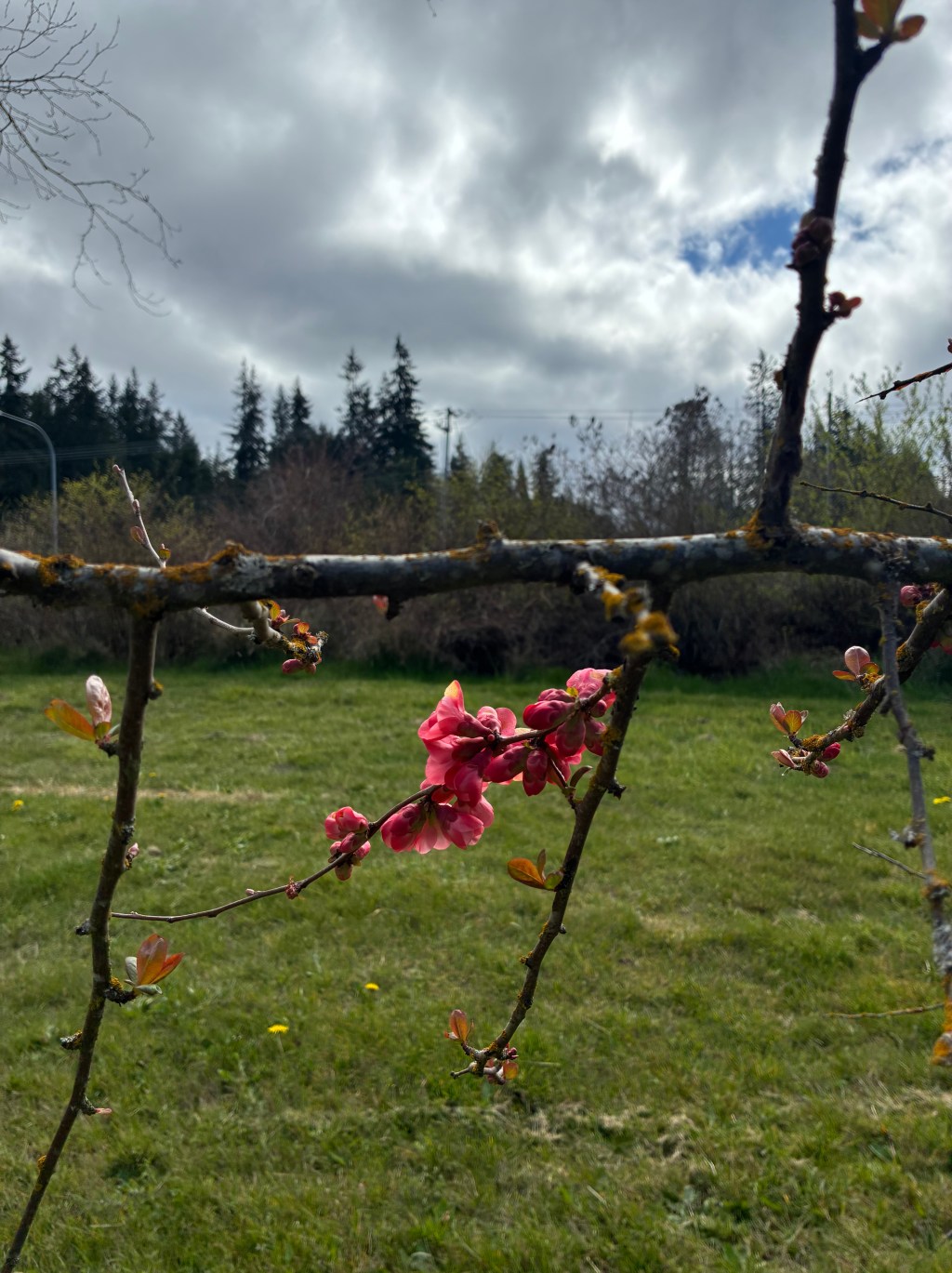
It’s early spring here in the northwest; trees are budding, grass is growing, and the flowers are starting to emerge. My four year old showed up with a bag full of dandelion heads she plucked for Grandma and I and she hasn’t begun to make a dent on the yard. Instead of yard work, I have two writing exercises for you this week.
First: Write a short story with a flower as the central character.
Second: Pick a spot where you can spend a few minutes a day (or week, whatever suits your needs) and write down what you sense there (all six of them) keep going back as the season changes. Notice what is blooming, what the smells are, How you feel in that space.
Happy Writing folks!
 Mamasquatch the Writer
Leave a comment