Yesterday I spent hours sitting at my kitchen table talking, or typing to customer service representatives. Nine of them. The Grizzly tool guy was a human right from the start and chatted with me for 45 minutes about wood turning, my out of print lathe and where to find parts, and general info about resources in the wood arts world. Top notch customer service. I spoke with two people at USAA who helped me get all of my passwords reset and my safe driving app online. Top notch service. Then there was Old Navy.
Two weeks ago I ordered matching outfits for everyone for Easter (per the oldest daughter’s request). Of the nine things I ordered, three showed up. Five bot chats that led to five eventual people hitting canned response answers (during the middle three I was “timed out” while they told me to please wait 2-3 minutes while they checked on my problem) we got things sorted. But only because I figured out if I just kept typing during those 2-3 minutes (which was eventually 37 minutes) that the computer wouldn’t time out the session and make me start over.
If you are ever in a writing slump, get yourself on a customer service line and do some stream of consciousness writing for 37 minutes. Somewhere in India there is a person who got to read some of my best prose ever. And before you think I was awful and rude, no; I’ve been on that side of the customer service desk at Walmart during the holidays. I will never be rude to someone doing their very best to make a paycheck while helping a girl out. I let them know why I was writing a novella on the response screen and kept it fluffy and light.
All of that is an excuse as to why this is coming to you on Thursday. I only had so much emotional energy to expend and Old Navy took a year’s worth. But here we are a good night’s sleep and an hour of princess puzzles with Linden later.
Last week we discussed what to consider when world building. This week we are going to zoom the camera in on Arenas. After we’ve built our spaces, what do we put in the rooms?
For our purposes today the Arena is the space the action is currently taking place. Right now the arena of me in this moment is my master bedroom. The curtains are closed but the room is bright from the grow lights on the bookshelf. I’m sitting on a made bed next to my daughter who is doing her math; our cat, ‘Snuss, is snoozing next to me, and a hot cup of coffee is steaming away in a 2005 ren fair mug I found at a thrift store. In the background I can hear cars on the highway and a Polynesian history video on the tv in the living room.
Let’s write this moment into a scene.
“Turn the video down please,” I called to Moss. The noise of the tv was distracting even from my perch on the bed two rooms away.
“Right?” Violet leaned away from her math book to scratch ’Snussy’s fuzzy head, a handful of cat fur coming away in her hand. “I can’t hardly think with all these distractions.”
I reached for my coffee on the nightstand, hoping that a sip or two would motivate the words I was searching for to come out of hiding.
“Maybe there should be zombies?” I muttered to the blank scrivener document staring at me from my laptop screen.
Violet glanced toward her math book again. “If there are, I’m not bothering to learn quadratic equations.”
We didn’t need all the arena information to write a cohesive scene. In fact, adding more would have bogged down the action and dialogue.
“Turn the video down please,” I called to Moss. The noise of the Polynesian history documentary was distracting even from my perch on the well made bed—except for the tan king sized fuzzy throw I had found at Costco the month previous, which was crumpled messily beneath our cat and my daughter, Violet who sprawled next to me—The tv was two rooms away—if you count the long hall and staircase as a room, and yet I could hear every word…
We want enough information about the arena to support action and dialogue, and we want to seed any objects that are going to show up later in future scenes. For instance if three scenes after the one on the bed I pick up a chicken stuffy and run into the living room to start beating the tv with it, then I am going to seed that chicken stuffy in an earlier moment:
“Right?” Violet leaned away from her math book to scratch ‘Snussy’s head, a handful of cat fur coming away in her hand. She wiped it off on the giant stuffed chicken that ‘Snuss liked to drag around with her. “I can’t hardly think with all these distractions.”
This is kind of the reverse Chekov’s gun moment. As an author we know the gun/chicken is going to be used in the final scene, so we need to place it in the first act.
We can also include details that create ambiance. Sensory details affect our characters just as much as they do real life folk. Use very specific verbs, adverbs and adjectives to set the vibe of your story in a concise way.
“Rain pattered on the roof; we stretched our toes toward the fireplace trying to capture the warmth with our wool socks to save for later.”
“Raindrops slammed themselves against the window panes like Wellington’s army at the walls of Salamanca.”
“Rain ran through the gutters and tapped rhythmically on the porch outside my bedroom, each drop eroding further the remnants of my sanity.”
“Rain turned to a tentative snow, hesitant to promise a three day weekend.”
Mold in the sink suggests something far different than mold on a log in the forest. The sound of a baby crying after being born evokes different feelings that one at the start of a transatlantic flight. Instead of telling us George thought a room was boring, write about how the color of the walls suffocate him with their eggshell nothingness, a reflection of how he feels about his job and marriage.
I love it when the Arena becomes a character itself. I use implied intent and personification a lot in my setting descriptions. I want the space to feel almost sentient.
“The hallway floorboards acknowledged my presence with a groan.”
“My van slid her side door open as I sprinted through the quarter sized hail. Pulling Mossy from under my sweater, I chucked him the last three feet into John’s waiting arms and vaulted over a puddle into the safety of the vehicle.”
That last one actually happened.
Admission time: I am a wordy writer. I love nature writing; I love lush settings; I want to know what kind of gravy is on the biscuits in the background of a scene. I want to see it dripping down the character’s chin and be wiped up with a pink floral napkin left over from someone’s tenth birthday party. But not every story calls for that.
My suggestion is to throw it all in in the first draft and edit later. You would not believe how many random things I start out with in my settings. Cracked teacups, yellow vests, half finished knit hats, a crust of bread that fell off the table; some of my most delightful story events have happened because I seeded the possibilities in the arenas.
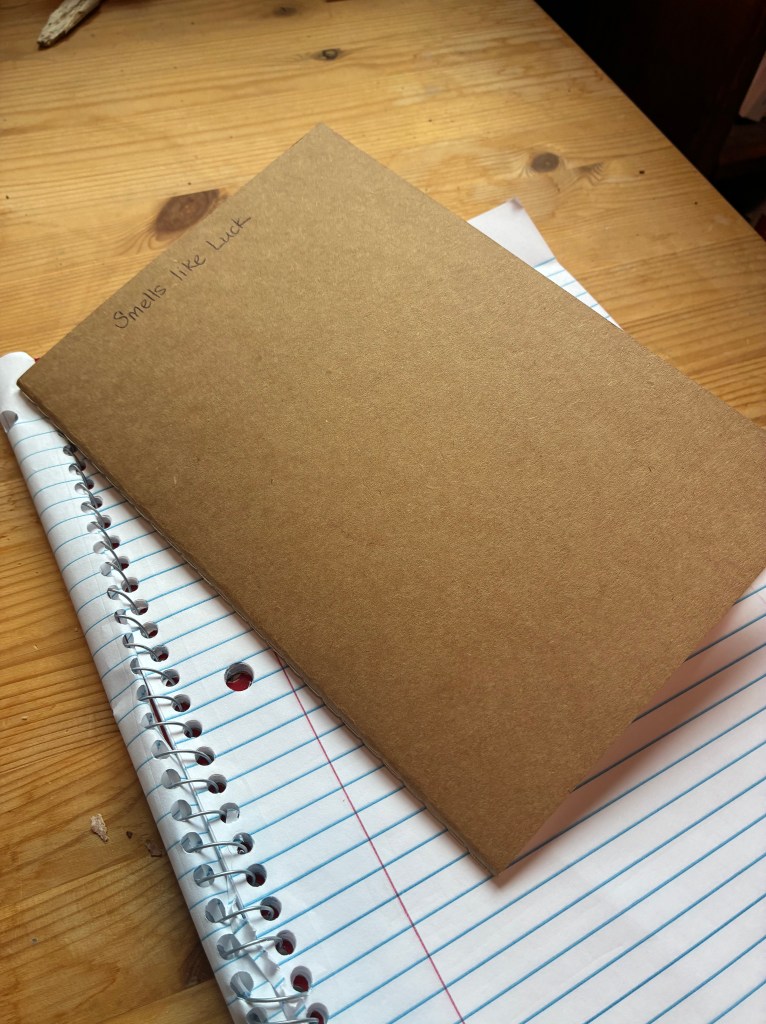
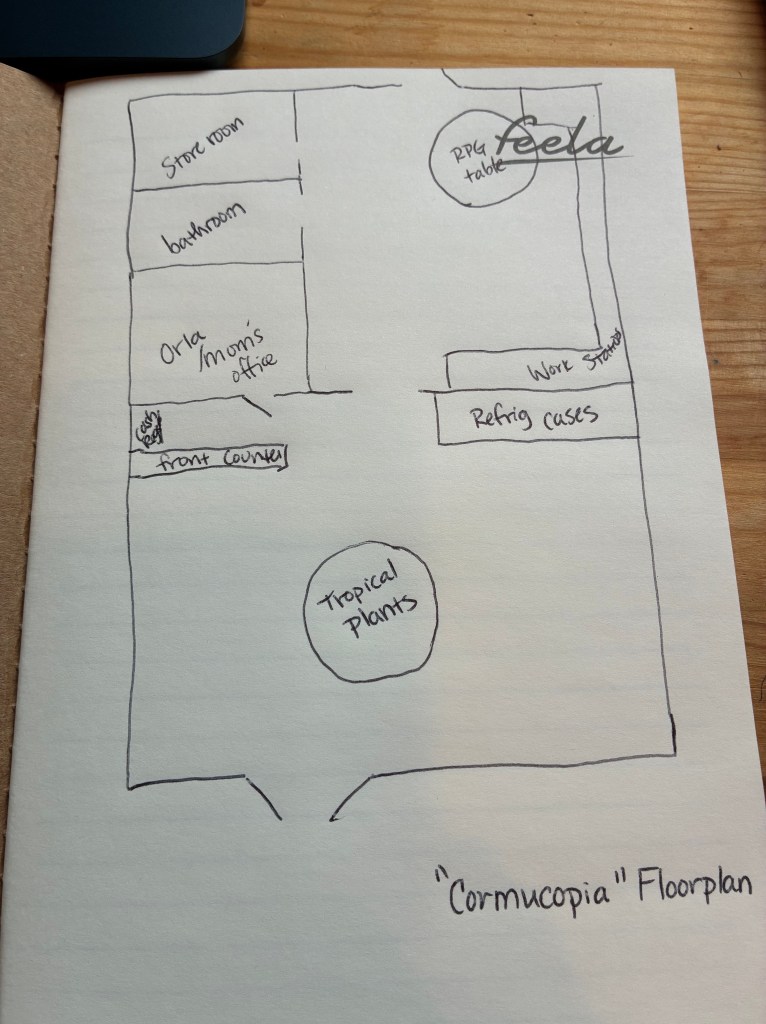
We are going to wrap up with a hard won piece of advice. Sketch out your arenas as you go. Just have a nice little notebook for each of your stories, and do a quick pencil drawing of how you’ve described your space. Three chapters later you will thank yourself when you’re trying to figure out if your character can grab the cracked tea cup to throw at the intruder trying to steal the magical yellow construction vest (which allows the wearer to build any physical structure they can imagine, which will then stand firmly for three minutes before dissipating) or if they are more likely to try and stab them with the knitting needles or blind them with the crumbs from the bread crust.
A writing activity for this week: Sketch out your arenas! I swear, it is really fun.
 Mamasquatch the Writer
Leave a comment