My writing renaissance began with Dungeons and Dragons. I hadn’t written much in almost a decade when I started playing D&D, but then the DM of our campaign asked for 1000 words of backstory for our characters. The next week I sent him twenty-two pages. It would be another year before I applied to grad school, but in that time I started running games myself, as well as dabbling in fiction and creative non-fiction writing.
In my fiction work I took the same direction that I did when creating an RPG campaign: I created a world and some characters and I would let them wander. It works fairly well.
A few years down the road I’ve discovered that world building isn’t something that we spend a lot of time teaching. Sure we talk about setting, but often “setting” is more “stuff that’s in the room/ambiance/location details” than comprehensive understanding of how the characters are functioning in a space and why.
So what do I mean by World Building, World, and Arena? (Okay, I haven’t mentioned Arena yet, but we are heading that direction.)
World Building is a method of setting up all the dynamics and elements of a story within the context of the World around the central character, regardless if those dynamics are seen on the pages by the reader.
If your story is about an ant that lives in an acorn at the base of an oak tree in a yard in Norfolk, Virginia, in America, on Earth, then you would want to know what is happening in all those places that might affect the ant. Are we going to see what is happening outside that yard in Norfolk? Probably not, but you as the author need to have a pretty solid idea.
Why? Well depending on if the yard is in an HOA neighborhood, acorns may or may not be allowed to linger in the yard. Lawn mowing could disrupt the ant. And Norfolk is a military town so if there is a global conflict that pulls the homeowner away, then the yard may turn into an ant paradise! The point of world building early on is to make your story feel cohesive.
As a writer almost done with the first draft of the third book in a much longer series, let me tell you, I don’t regret any of the world building I have done. It has saved me on edits.
Note here: Depending on the length of your story, you really may not need to fill in every detail of the greater world. A flash fiction piece is going to require much less world building than a ten volume series.
When I talk about the World of a story, I am using it as a general term describing the largest circle that is going to affect the characters. Acorn, yard, Norfolk, USA, etc. In a made up world this could be many more rings of depth away from the arena of the story, but in the world we live in, your story’s world may not even be global.
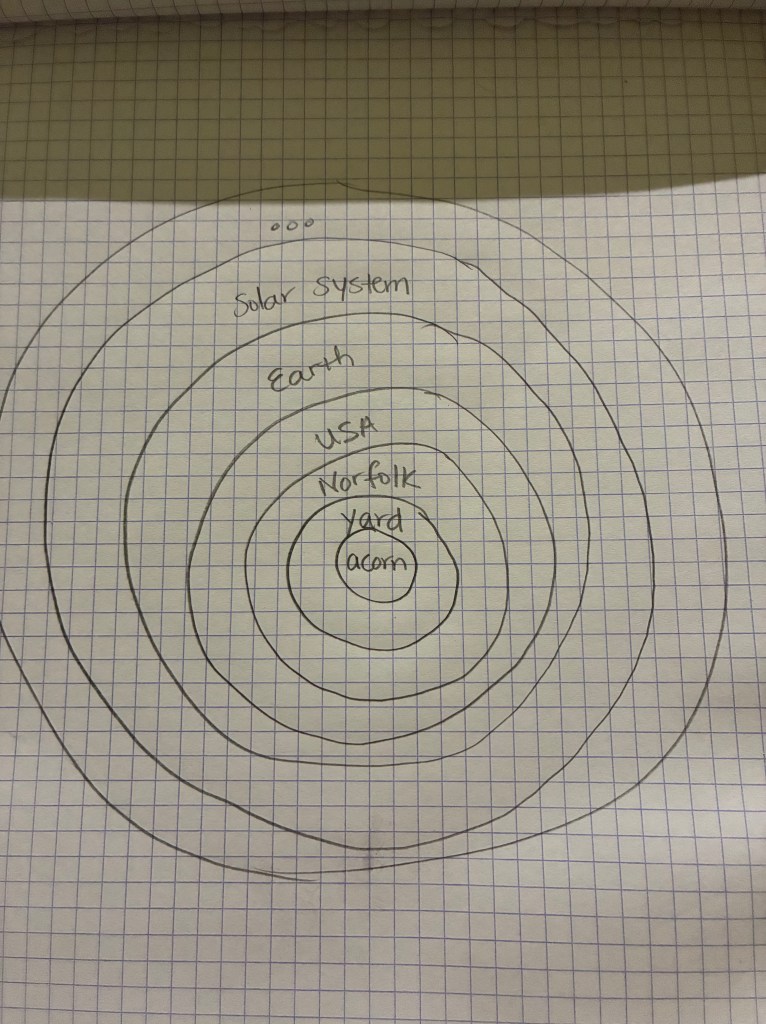
Arenas are where the action on the page is taking place. The Greeks were all about plays taking place in one arena, but then they really got into epics as well, so who knows. “Arena” is a fairly technical term, but good to know for formal educational settings. If our ant story is a short one, then maybe the yard is as far as the reader sees. If the ant takes a hike into the neighboring yard, then the arena either changes totally or gets a little bigger depending on how the scene is written.
Much of your world building is going to be done on an Arena level, as it is fairly mandatory for all stories to have a setting of some kind. As noted above, world building beyond that is at the author’s choice.
So where to begin? I generally start with the question “Is my world different than the world of my readers?”
Figure that unless you are writing in a familiar IP world, that your readers are going to assume that the world of your story functions in “real world” territory. If in the first sentence a dragon shows up or a kid needs weighted shoes to keep from floating off, then the reader figures out that things work differently here.
Note: General Fiction takes place in “real world”; Speculative Fiction takes place in “real world with a what-if? Like vampires, magic, England won the revolution; Magical Realism takes place in the “real world” but if magic/miracles/extraordinary things happen but aren’t weird; and Genres like Science fiction, fantasy, and horror can take place in all sorts of places. The lines of distinction are wishy-washy.
Assuming that your world is different from the real world— or the modern world if you are a historical fiction writer—then the next question is How?
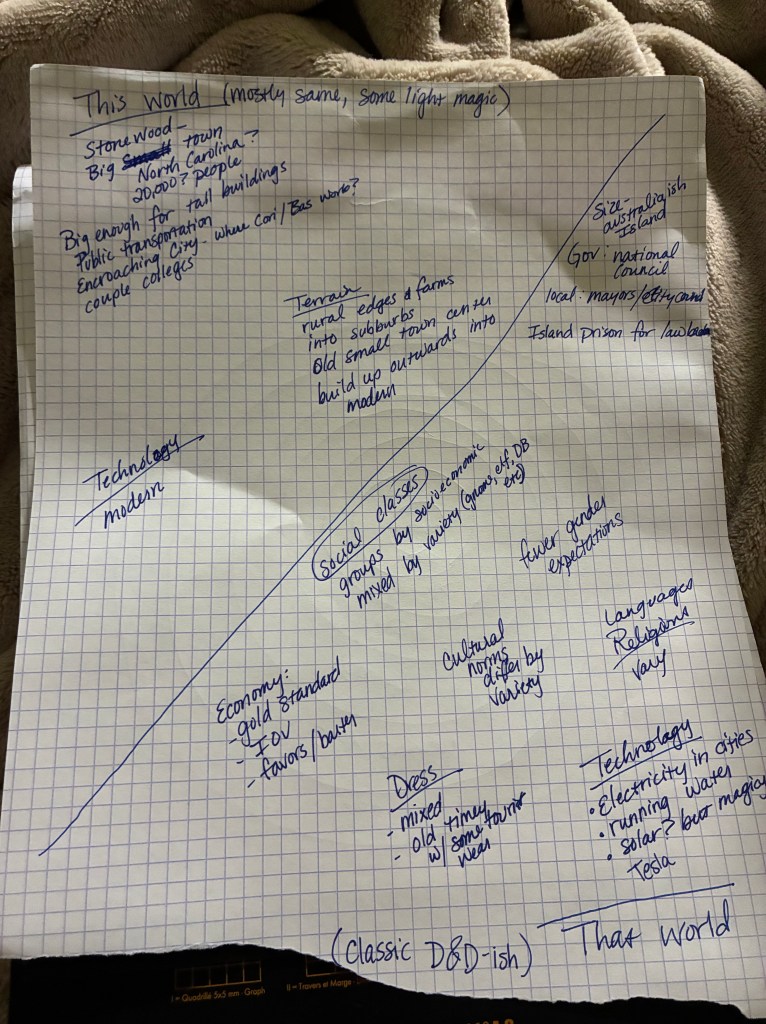
Some areas to consider:
-Government
-Social Classes
-Cultural Norms
-Weather
-Terrain
-Solar functions
-Gender expectations
-Technology
-History
-Languages
-Family Systems
-Dress
-Economics
-Religions
Do you need to write a dissertation on all of these topics before you start writing your story? No, of course not. But being aware that these elements are shaping the motivations and goals of your characters is a must. More importantly, understanding that your readers need to see these differences on the page to understand why they are shaping the motivations and goals of your characters is a must!
If in your world parents give up their children to the state in order to save them from a cruel fate of being eaten alive by ghosts, then we need to see ghosts eating the unloved children who are kept home in order to understand why all the institutionalized kids are so functional.
If in your world there are caste systems and your main character has been trying to escape their caste and make a better world for themselves, then we need to see the discrimination in action. The reader may not need to know the history of the forming of the caste system but as an author you might need that information so you know how it might be dissolved.
After the reader understands “how” the world is different and impacts the characters, world should fade into the background of the story—unless it is a character in its own right (different blog)—and the author can begin focusing on the arena of the story (also different blog).
That is the what needs to happen, but we also need to think about when it needs to happen. Technically a story needs a character, a goal, and an obstacle. I have written many a short story based on this formula with little initial thought to where its happening or what the tidal schedule is, and its fine for a scene, but as soon as the characters move out of their first arena, the world becomes a real world and questions arise.
The more similar a story world is to the real world, the less thought there needs to be ahead of time or early days on the page. But even in a modern fiction novel you need to think about what is happening in your character’s world that are shaping the events of the narrative. The big systems are the same but local events, weather, cultural norms, and family structures vary vastly by location.
Speculative fiction and beyond are a different animal when it comes to world building. I cannot encourage you enough to figure out your magic systems before you get too far into your narrative. Magic has to make sense and have as much order as any science or it begins to feel Hand of God-ish. At my last writing group meeting I listened to my bestie take apart an entire plot line with questions about astro physics and then turn around and do the same to my new magic system (he helped put both back together afterwards, don’t worry.)
The point is, readers know when things don’t make sense and anything involving magic has a lot of potential to get mussy cohesive-wise. The other issue with magic is that it changes the rules of the rest of the world which means that you have to set up those world standards for the reader. None of this means that the reader has to understand how your magic works right from the start; your characters might not know how the magic works; you must.
One last element of of world building for today is maps. I actually draw out maps for my books—or in the historical fiction side of things, find actual maps from the times and places I am writing. With historical fiction there are enough history geeks out there that will call you on your anachronisms, so you want to get it right. One of the best ways to world build is to actually visit a place, walk the streets and fields, see the buildings, eat the food, hear the birds. Feel the space. But maps are great too.
Thinking about the scale of your world will impact your plot more than you imagine. How long does it take a character to move from place to place? How are they traveling? Is there traffic/bridges/ferries/obstacles? Watching Grey’s Anatomy drives me nuts because the characters zip all over Seattle and surrounding areas as if they are teleporting.
Maps also help keep your story cohesive. I promise that six months into writing a book you will not remember where you said the bank was in chapter two, if the characters aren’t dropping in there regularly. If you don’t want to go back and dig through your chapters, just pull out some graph paper early on and sketch things out. Do it in pencil.
So those are the basic elements of world building. Do it early, revisit as needed, and remember that you can always change things that aren’t working for you. Next week we are going to step in a circle to Arena and look at how to incorporate setting into the action of the page.
For an exercise this week: Take the categories we’ve talked about and jot down a few things from a story you are working on. Does it change the way you think about the characters or plot?
 Mamasquatch the Writer
Leave a comment