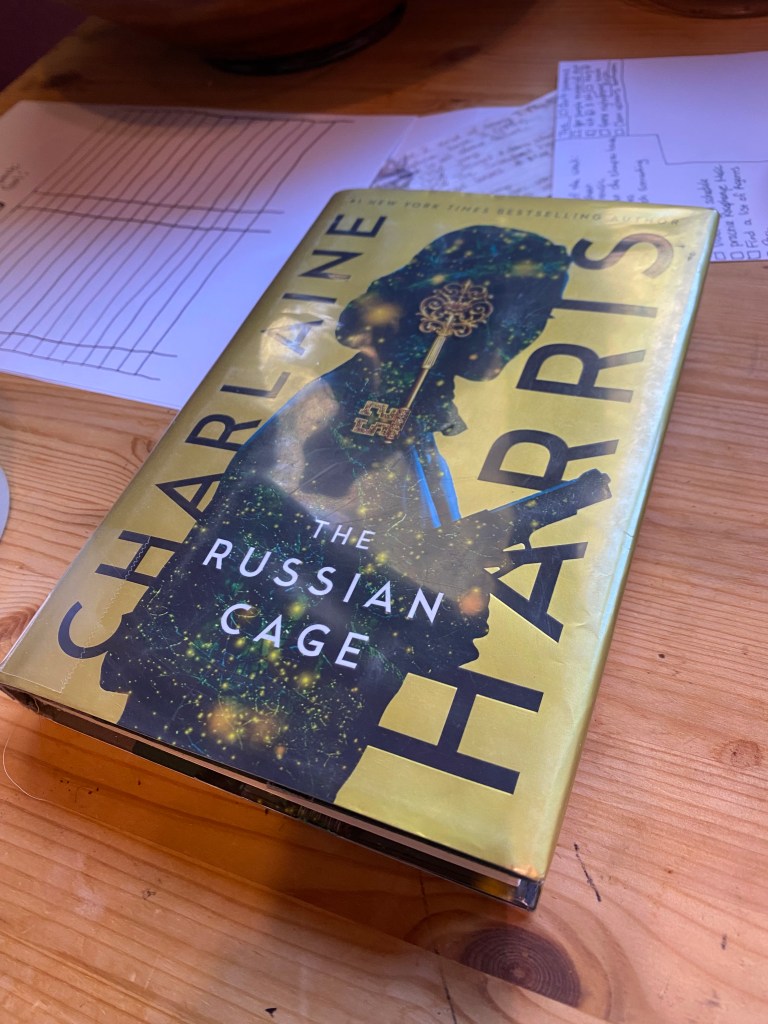
Between the regular schedule, Girl Scout Investiture, school conferences, and Halloween, I wasn’t planning on a very productive writing or research week this week. I also wasn’t expecting to read the first three books in a series.
I have been a Charlaine Harris fan for awhile, starting with some of her early mysteries, then the Sookie Stackhouse books. It’s been a few years though, since I’ve read her work and I was pleased to find she is as entertaining as ever. While the books have some flaws, they still held my attention well enough to keep me reading all week.
The series follows a young woman in an alternate history of the US, if Roosevelt had been assassinated and the flu had been an ongoing issue after 1920. In Lisbeth Rose’s world, the US has broken up into several different countries (or been annexed) and she has become a hired gun to get cargo—human and otherwise—across dangerous territory.
There is magic in this world as well, though wizards get a mixed reception depending on which part of the continent they are in. Lisbeth has some trauma about wizards but in the first book takes a job gunning for two on a strange quest that takes them on quite an adventure.
The first two books in the series feel like old fashioned westerns. The action is quick and frequent; the characters do bad things in the name of the mission. The characters are well written—though perhaps under flawed and over quirked—the relationships are paced with a masterful hand. The resolution of the first book is satisfying, but comes two chapters before the end of the story which then packs what might have made a pleasant Afterward into what instead feels like fifteen pages of “and then…and then…and then…”.
The second book takes up where the first ended and explores more of the fictionalized country, this time an independent racist south. This time Gunnie Rose has to act like a lady, even though it makes it much harder to get the job done.
I appreciate Harris’s use of societal pressures as a way of diminishing the protagonist’s abilities but the sense of danger in the first book is also diminished because the antagonists never feel that capable. Still, the relationship progression and some new characters do keep the story moving. This time the ending comes at the right place.
Book three took Gunnie Lisbeth Rose to the West Coast on a personal mission. This has been the weakest book of the series thus far. I understand that the author was putting her protagonist in new situations to change up the action pattern—which I appreciate—but she spent much of the book walking or driving from one place to another, often not talking to other characters. The characters that we did see were either obnoxious or written with less dimension that previous allies and antagonists. Still, I am looking forward to reading the two other books in the series that I borrowed from the library.
Right, so there were a couple things that perplexed me about these stories. First, Lisbeth hates being dirty. Okay. Over and over across the three books, she washes her face, takes baths, scrubs off blood and dirt, etc. Normally, if something is such a huge deal to the character there is a reason for it that we learn, or it has some sort of narrative purpose (the character is in the bathroom washing her face at a pivotal moment and doesn’t get shot) but not here. In three books I can’t recall one important tie in. Weird.
The second and much larger issue I am running into is the anachronisms. Because this is an alternate history of the US, technically they could have had hose in the 1940’s. But since pantyhose weren’t invented until 1959, it feels like she should be wearing stockings. In one book she even mentions garters, but then it reverts back to hose. She also puts clothes in a “clothes washing machine” in one book.
The books never quite lay out what year these stories are happening in, but since one of the characters is born while fleeing with the Tsar after the Russian revolution and is now maybe 25, AND in the last book they mention how San Diego is filled with unemployed military folk from after the war my guess is mid 1940’s. Now the problem with all that is, as a reader, I am doing math.
Instead of staying in the narrative I am trying to make the dates match up. Instead of enjoying the story, I am arguing with myself about which modern things might have still existed. Maybe some of this is nitpicking because I am a hisfic author who spends a lot of time getting my details correct, but on a similar note, most of the characters—even minor ones—speak with similar tones: same formality, same slang, same dialogue patterns regardless of class, education, or cultural background. This may hold today, but in 1940 a Russian princess isn’t going to be using the same slang as a southwestern gunslinger.
Overall, I highly recommend the Gunnie Rose series. It is a great easy read; I could get a few pages in while waiting for the kids, as well as enjoy a some chapters before bed.
I’ve heard over and over that to be a good writer you have to be a good reader. This series so far has been a great example of the importance of likable relationships and fun action scenes, as well as why we make quirks narratively relevant. Chekov’s bathtub, sigh.
 Mamasquatch the Writer
Leave a comment