What are your characters saying in their heads? Why is it important?
As I’m writing this, Violet (12) is trying out her hand at story openers for a Campbellesque personal narrative. As she stares out the window for the thirtieth minute, attempting to think of an appropriate onomatopoeia, I sit at the kitchen table making my own tale. We’re trapped inside due to forest fire smoke and sitting on each other’s last nerves. Trust me when I say my internal and external dialogue are miles apart.
On the outside I am using my best calm teacher voice, asking how I can be helpful; what does she need explained; should we try another example? On the inside? I am screaming. SCREAMING. How much I hate homeschooling, how we should have moved somewhere with better fitting educational options, how I want to be upstairs pouring creativity onto a page rather than sitting at the kitchen table feeling grouchy.
The compelling part of the story is happening inside.
- Internal dialogue creates a bridge between external reactions so that the reader understands when the Mom Character—after being interrupted thirty times with questions about the process of heating up soup during which she patiently answers questions and assists with choosing pots—drops her head in her hands and hisses “Oh my god!” When question thirty one is accompanied by the vigorous clanging of metal spoon on metal pan.
- As the character is often a shell for the reader to step into, adding internal dialogue sets the tone for how the reader is supposed to feel when the context clues maybe ambiguous.
- Dialogue, both internal and external, deepens the reader’s understanding of the character and their development; it gives the reader a peephole into a character’s psyche.
- Sometimes an element of a Character is their introversion, or lack of speech, eg: Tommy is scared of speaking out because he sounds like a foghorn when he opens his mouth. Internal dialogue allows for his side of the story.
Readers like to feel the weight of action. How does it make a character feel to wake up on the floor of a cheap motel room after a night of pixie sticks and late ’90’s cheerleading movies? Is it regret or delight shining in a man’s eyes as the rollercoaster crests the hill and begins to separate from the tracks? When Tommy has to make the choice to face down the wizard that cursed him or save a ship heading for the rocks, why is he making the choice he ultimately does?
We will know the answer because of the internal dialogue…or if the character gives a loud villain exposition to anyone in hearing distance…or you are excellent at describing physical and emotional cues.
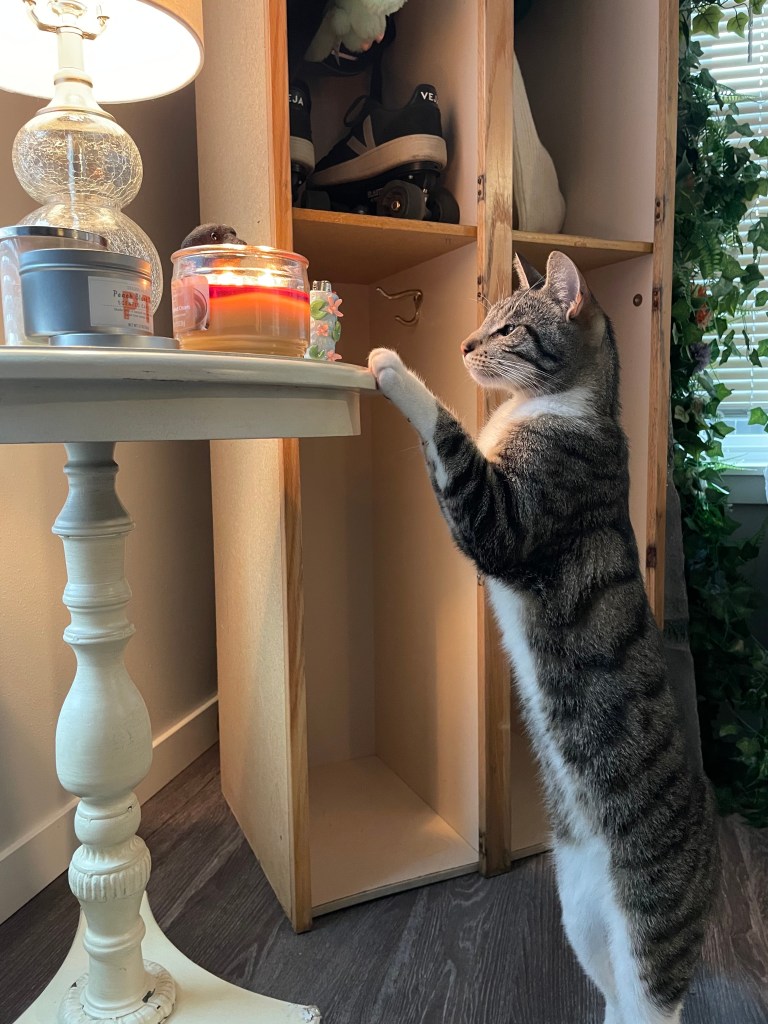
PS-Violet decided “Mwrowwwr” was the appropriate onomatopoeia for an angry cat.
 Mamasquatch the Writer
Leave a comment