Let’s talk drafts.
Okay, everyone talks drafts. But that may be because everyone asks about drafts.
The most common comment I get is “I want to be a writer but I can never finish a project; I get midway through and have to start revising.”
I get it. My first semester of grad school was spent agonizing over and rewriting the same thirty pages while my professor muttered something about “stakes” and talked about cats. Thankfully, my second semester was under the tutelage of Julie Hensley, who gave me the wise advice to just keep going until I had a draft. By that time, I was so traumatized with that first novel, that it went into a folder on my desktop and hasn’t been opened since.
My second attempt at a novel went far better. Over the next year and a half I wrote a book. It did go through several drafts, but not in the traditional sense that I had been taught in school—Outline, first draft, revision, turn in. My eyes were opened to the variety of ways a “draft” can appear.
Speaking it Aloud
I spend a lot of time walking up and down my winding driveway, talking out my plots with whomever will listen. Often the first version of my stories plays out aloud three or four different ways, as I hash out details and character ideas.
My friend, Holden, acts his first drafts. He plays all the parts, running trial dialogue and finding the characters’ voices both literally and figuratively before they hit paper.
Whether you consider this brainstorming, outlining, or drafting, speaking aloud your ideas counts as part of the creative process of writing.
A stack of 3×5 cards and sticky notes
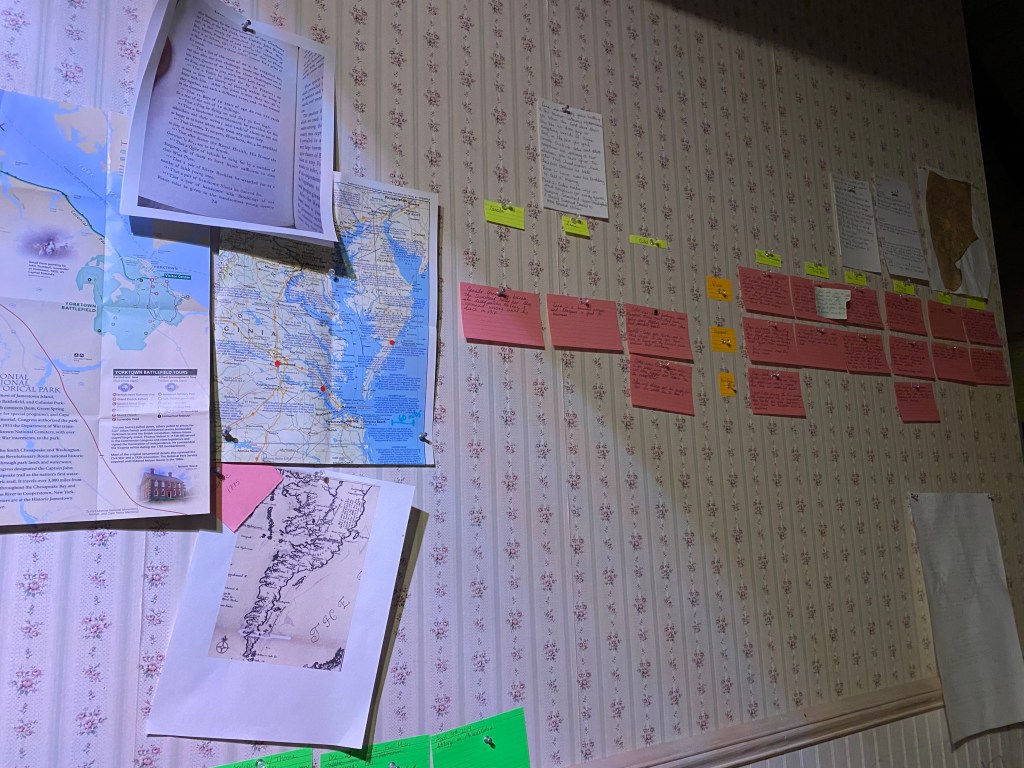
As a Hisfic author, who deals with primary and secondary sources, I use a lot of 3×5 cards. I currently have four different murder walls running. As I am researching, ideas/facts/potential characters/events all go on cards that get tossed in organized stacks. Eventually, those stacks turn into a loose outline, then a tighter outline, then a draft.
I wouldn’t consider this a “first draft” yet, because there isn’t the narrative flow that a spoken or written version contains, but the function is the same.
Digging for the Clay
The first paper draft of a piece will often look nothing like the final result. I think of my first drafts as digging for clay. I just have to get the ideas together into a lump to shape later.
Now to be fair; If I have already done my verbal drafting and have a wall of cards up, the digging is pretty easy. (Refer to my Storybuilding article as well for some hints on pre- and mid-draft story prep work that also make the digging breezier.)
There are only two types of revisions I do during the first draft:
1. Character Voice work: sometimes it takes me two or three (or fourteen) tries at figuring out a character’s narrative voice. It is so important, I wrote an article about it! If I’m struggling with the voice, I take the time to switch things up before moving on. Usually, I know quickly when I click in to the right tone, and then, things start progressing more smoothly.
2. POV/narrative distance: I have been a couple chapters in and decided to try a different point of view (shifting from first to third person or past to present tense). Regardless of whether I decide to change or not, I go back and make things cohesive. This is a personal decision, but my brain freaks out a little when I am digging around in a previous chapter and suddenly it is the “wrong” whatever.
Those are it. The things I don’t change? Previous plot holes; I just note down on the side of the scrivener doc or in parentheses what has changed since I wrote it. Character changes; again I note the change when it comes up (the character has an accent now? Fix it in the next draft.) The whole thing now takes place in New Jersey? Write it on a card and keep going.
The goal of Digging for Clay draft is just to get it on paper. This is the draft where the crazy non-canon stuff happens. We don’t care if the character is consistent! If something is nagging at you, toss it in and see where it lands. Seed the impossible!
Sometimes I end up with three different versions of an event, or two different possibilities. Sometimes I don’t have an answer or haven’t done some specific research I put empty parentheses or a short description of what will go in place eventually. Eg.(prospective historical villain). Sometimes I throw in a random thought that becomes the unexpected linch pin of the entire plot.
When digging for clay, we want to allow ourselves the freedom to find gold.
The Workshopping Draft
Part of the magic of a first draft is that no-one ever has to see it. In fact, rarely does anyone see my first drafts: I don’t want them reading the next one and being totally confused at why a certain character seems to have married someone else while three others don’t exist anymore.
Once you have a big old pile of story clay, it’s time to shape it into something you want people to read.
I personally take a couple days and go away to a quiet place for this part of my process. I read through the entire first draft and change the easy stuff, line edit, and note major work that needs to be done. Then I hit those empty parenthesis, the character inconsistencies, the plot holes and dangles. Sometimes that is enough.
Other stories require more revision. I have cut entire plot threads that, while delightful, didn’t matter to the character’s growth, or further the tension in the narrative. Characters get combined or cut completely. Sometimes I need to write whole chapters to give emotional balance to relationships or to make the pacing feel more natural.
The end goal of this draft is to have recognizable character arcs and a story that resolves the central tension of the narrative. In other words, it should feel like a story. It may take a lot of revisiting to get a piece to this point and that’s okay! It’s natural! It’s part of the process.
And Beyond
Once I have a workshopping draft, I like to let it sit. This allows one to forget all the little details (I swear it happens) and gives distance to the critical eye.
My writing group only meets once a month for workshopping, so I have plenty of time to let my work breathe before I have people giving me feedback. When I do get comments I like to address them when they are fresh. Now, let me be clear: You never have to accept other folk’s opinions about your work. I like new eyes on my pages.
Often my writer friends can give me words to express what I know isn’t working. They aren’t coming to my work with the knowledge base that allows for conclusion jumping. They are loving and critical in just the right balance and my stories are better for their feedback.
So once I have feedback, I try and sit down and work out the changes I want quickly. Then I move forward and read the next chapter or two with those same comments in mind, and make those changes as well for our next session.
Eventually, I have a draft that I am ready to send out to agents, journals, or contests.* And even then that is really just the start of a new set of drafts.
To wrap up here: Write. Just write. Don’t worry about the final draft, just dig for that story clay and get it on paper.
*The length of the piece might mean that I skip any one or more of these drafts. Some magic nights you might just dream something that is ready to go the moment it hits the page.
 Mamasquatch the Writer
Leave a comment