We’re back from Homeschooling month! Speaking of feral children… Since the Enlightenment philosophers, then psychologists have been trying to suss out what makes folks into “good people”.
For awhile the idea was if you gave someone the right education they could rationalize themselves into morality. Then someone else said “Hmmm, maybe environment matters?” Eugenics was shaped around the idea that morality was tied to blood and family history, and the whole “Nature vs. Nurture” argument really got rolling. At some point someone pointed out that maybe things could exist on a spectrum and might be a little more complex than any one theory could sum up.
American psychologist Abraham Maslow jumps in with a hold my beer moment and creates a simple chart that becomes the bedrock for developmental theory of needs and behavioral motivation.
Why is this important to you, the writer? Well first and foremost dropping “Maslow’s hierarchy of need” into a conversation is basically the same level of credibility cool as properly using semi-colons in an email; people gonna be impressed.
Second, the theory is a simple way to keep your characters grounded in reality.
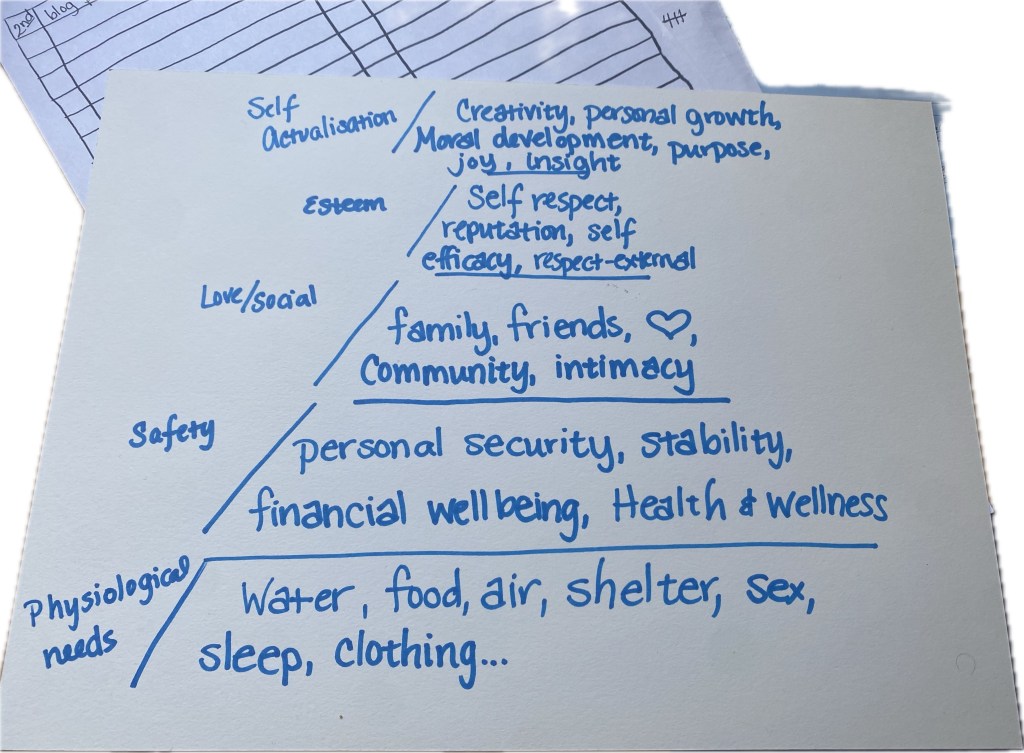
Maslow posited that base needs must be met before someone works up to the next tier. There is some variability as plenty of examples of people exist who have been ill or unhoused and still managed to have loving relationships, be wonderfully creative, and find joy/purpose/insight, but anyone who has worked two full time jobs to pay the bills will tell you they didn’t have a lot of energy left over for those upper tier pursuits.
As a historical fiction writer who primarily explores women’s lives and relationships, I know I am stretching the bounds of accuracy when I send my characters beyond the borders of their intimate worlds. Until well into the 20th century, working class women with families spent most of every day doing the basic duties to keep a home running. Those that worked did so to pay others to do those basic duties. Historically, women’s adventures were small and close to home.
There are deviations of course, fascinating characters from History who escaped the drudgery of home and hearth, donning pants and heading out into the wilds, the battlefields, the high-seas, but this doesn’t become even close to mainstream until WW2. These examples aside, most women were working sixteen hours days just to keep everyone from starving to death.
To keep my characters feeling realistic I weave action and conversation into daily activities. Everyone has a job to complicate their lives, to enrich their motivations. Speaking of motivation, another way to look at the hierarchy is as a measure of urgency. We seek to fulfill the base layer first, these are the most urgent needs; given the choice between eating and finding purpose, one generally takes precedent over the other.
1750 Boston, Constance wants to live independently and run a millinery shop. Such things cost money —roughly $300; while widows and spinsters might manage their own accounts, married women surrender property rights; should she raise the money by piracy or take a husband to foot the bill?
Perhaps Constance has two marital options. One poor but romantic, the other wealthy but cold. Most stories would have her choose love, but Maslow would suggest that personal and financial security is a more pressing need than romantic love (sex complicates things, being down on the physiological tier but in this instance just pretend that both guys are equally steamy). Do we as authors embrace the trope or the reality? Does Constance’s desire for personal security, her dream of owning her own shop, out weight the fact that Poor Pete is a great poet and writes ballads about her sparkling personality?
There isn’t a right answer to this story prompt as long as the context fits the choice, and the consequences follow. If Constance is struggling to feed and clothe herself(or three children from a previous husband) in the middle of winter and Rich Richard offers her and the kids a grand life if she will play the part of his wife and ask no questions about what is going on in the basement, vs. Poor Pete who can offer nothing more than a sonnet and some dimples? As a reader I am going to find Richard the more believable choice (also what is going on in the basement?)
If Constance is a wealthy young woman who longs for financial freedom but her father will only approve of Rich Richard as a husband? Poor Pete feels like a fine choice for an adventure. As a reader of this story I already know the physiological stakes are lower; I’m not worried about anyone starving to death, so I can settle in for some high pirate-y shenanigans.
Character arcs generally follow Maslow’s hierarchy as well. Finding love, purpose, family, community, etc. are frequently the driving force of a character’s personal growth. The trick is? The movement has to feel plausible. If Constance is shivering on the street and we write a scene where she finds joy in the situation because someone uses her picture to create a poster for the new sanatorium? That is going to be a hard sell to the reader. If Constance is shivering on the street and uses her mimicry skills to make a sad guy laugh who offers her a job as a housekeeper (as long as she doesn’t go into the basement), I am going to keep turning pages.
I love a fall from grace story, and Maslow works in the opposite direction as well. How many preachers, musicians, politicians have we seen who seem to be at the height of moral development, joy, insight, with a calling from God themselves when something happens and their reputation is tarnished? They lose their family and friends, their community? From there the bank account goes, etc.
Back to keeping your characters grounded in reality: if you are struggling with answering a “Why is my character doing this?” moment, look at Maslow’s hierarchy. Does the behavior match the need? Are the plausible consequences worth the risk?
Writing Prompt!
Come up with a character and give them two good choices( or two bad choices— whatever suits you) jot down what needs would be met by each action, and what some of the consequences might be…
…..also, what’s in the basement?
 Mamasquatch the Writer
Leave a comment