The first year I homeschooled I went to a huge conference in South Carolina with nationally known speakers, workshops, and a stadium sized curriculum fair. I had a background in education and had done quite a bit of curriculum development myself. Five minutes after walking into the maze of vendor booths, I was short of breath and starting to panic.
Homeschooling is hard. Mentally hard. Emotionally hard. Spiritually hard. For many there is no safety net; you screw this up and your kid’s life is ruined. (Not REALLY! But we sure feel that way in the beginning!) Curriculum developers know this fear and make a lot of promises to get their cut of the huge homeschool education supply market.
The truth? Curriculum is a vehicle for information.
Curriculum is information set in a particular sequence, taught using different methods. That’s it.
There are opinions on every product on the market and let me tell you, there are plenty of options out there! The trick is finding what works for you as the instructor, and your learners. * Whenever someone asks me where to start with their curriculum journey I send them to Cathy Duffy’s Curriculum Review website. There is also a book version of much of this information available at every library I’ve ever been to. There is a free “what kind of learner do I have?/What kind of teacher am I?” quiz that will help narrowing down the field.
Basically, people tend to learn in different ways. Visual learners may need to watch something being done or see a timeline on a page to understand the process. Auditory learners learn by hearing. Kinesthetic learners do best with movement, etc. We also retain knowledge differently. Some learners will need to have information taught several times (the spiral method), while others need a mastery approach (learning all the steps for something, then moving on for good). And none of this takes into account learning issues, or differences in cognitive development.
Just like learners learn the way they learn, teachers are going to teach the way they teach.
I am not a routine person. I don’t love sitting and monitoring my kids while they do (or do not) their math. I love doing the research and development but then want to hand it over and let the kids do things fairly independently. Reading out loud just about kills me. The good news? There are some great curriculums out there that fit my teaching style!
The homeschool curriculum world has changed dramatically even in the past ten years. When I was getting started back in 2012, there were few secular options, few online options, and the content was “Traditional” (hierarchical, western focused, colonial, with a teacher teaches-students learn dynamic). Now there is a generous selection of de-colonized, collaborative options available across a spectrum of belief systems; online schools and class options abound.
So with all the options, how does one choose?

After getting an idea of what kind of teaching style/learning styles you are working with, it is time to decide what you are going to teach. This is going to vary depending on ages, interest, and state laws.
In Washington, my home state, you don’t have to register your kiddo for school until age 8. Afterwards, there are specific hours of instruction time required for each homeschooling year. (All states have homeschooling associations that are a wealth of information for the annual requirements.)
Classroom time can include direct instruction (traditional stuff), indirect instruction (kids working independently or project based learning), field trips, enrichment classes, art, sports, etc.
Subjects: Expect to cover math, science, language arts, and social studies at a minimum.
Skills: This depends on ages and stages.
Preschool- gross motor skills like running, hopping, standing on one foot (general playground stuff)
-Fine motor skills like coloring, playing with small toys, measuring and pouring, beading
-social emotional learning like naming feelings, setting boundaries, respecting “no’s”
– Creative play
-early literacy with reading aloud, learning sound concepts, word play, story telling
Note: I am a huge proponent of Montessori-style learning through second grade. I highly suggest forgoing traditional sit and learn style educations for young kids.
Elementary-Handwriting (let them start cursive as early as they like, especially if you have a letter reverser.) Reading/Writing for purpose/Math skills/and those other foundational skills. These are the years when we are taking advantage of the spongey brain and letting them soak up all the skills. Ideally, by middle school we want kids to be able to transition to learning new information and applying it to the foundations they have built in Elementary years.
Ex. 5th grader can write a few paragraphs about why they like pizza, or why kids should get all the video game time they want. By 8th grade, we want students to be able to think about different perspectives and argue both sides, or write and compare and contrast an essay including different potential solutions to a problem.
Ex. 4th grader memorizes multiplication tables so that when they start pre-algebra they aren’t getting burned out doing all the calculations not in their head.
By High School, ideally we are focusing more on real life skills like time management, resource management, and applying deeper understanding of the content of lessons to future life plans.
Ex. Karl uses his coding skills and interest in photography to make a website to sell his work.
Ex. Sara deep dives into victorian history and begins making connections between first wave feminism and current struggles in middle eastern countries, then begins volunteering with women’s rights organizations.
Middle and High School are also the time to try lots of electives and hobbies.
Preschool and Elementary curriculum will often have skills built in to activities and lessons; Middle and High School not so much.
This is because higher learning skills, like critical thinking and time management, are harder to define and measure—and are highly dependent on the individual and their pre-frontal cortex skills.
So back to first year homeschool mom Mamasquatch, in the amphitheater filled with vendor stalls. I had my list of subjects; I had done some serious research on curriculum styles…
Montessori. Classical. Traditional. Un-Schooler. Hybrid. Eclectic. Homeschoolers love to classify themselves and judge heavily everyone else. (Yep, I do it too sometimes. There will someday be a story about the cult I almost joined that time…) To an extent, these classifications are important because curriculum within these sub-groups is based on a specific type of educational philosophy. You want your curriculum to fit into your educational values.
Educational Philosophy Breakdown:
Montessori: Based on the ideals of Maria Montessori, kiddos are guided toward independent experiential learning with high quality manipulatives and real life skills. Kids pound nails into boards, learn animal taxonomy from three part cards, and work their way through red, green, and blue level phonics. There are plenty of free resources online, or skip the printing and laminating and order things on Etsy. Montessori hated busy work, so this isn’t going to be a sit and do worksheets program.
Classical: This system of learning goes back to the Greeks. The idea is that kids go through the trivium, or three stages of learning. Lessons should be appropriate to the learning stage. The first stage is memorization heavy; copywork, memory work, summaries, facts and timelines. By the third stage students are focusing on critical thinking and rhetoric. There is a lot of Aristotelian discourse involved.
Done well, classical educations turn out inquisitive, creative thinkers. Unfortunately, a lot of the mainstream classical presses are workbook heavy and have kids doing large workloads of subjects that can be dry even with the most enthusiastic of teachers.
Another note: Classical educations is highly western and prioritizes Latin, hierarchical systems, and Euro-history. While I pull heavily from Classical educational philosophy, I have never found a classical curriculum that was a great fit for…anyone.
Classical Conversations:This is a homeschooling co-op that began in North Carolina and has spread all over the world. Students meet once a week and learn with similar aged kids. Parents teach the classes using the CC curriculum. The flavor of the group is highly dependent on the members…It’s pricy. There is a statement of faith that is decidedly antithetical to classical principles, but the songs are catchy and your kids will come away with a fairly solid understanding of latin conjugations.
Traditional: In the beginning was Abeka…back in the 70’s there were a few Christian colleges and religious institutions that started creating curriculum for homeschoolers. Similar to the public school style of the day, there is still a market for this type of programming. Think textbook, workbook, repeat. I have used Apologia science for about a minute, and Seton press for religious education before. Many math curriculums would fall under this tag as well.
Unschoolers: Unschooling is a spectrum. At its best, unschooling allows for the student to direct their own learning. There is no formal curriculum, just a learning rich environment and real world application. (I am trying to be unbiased here…) There are urban legends in the homeschool world about unscholers who self-directed themselves into top colleges and careers, but I’ve never seen that myself. All of my grown-up friends who were unschooled lament the years they spent as adults trying to patch the educational chasms that a basic math workbook could have filled. Thankfully, many modern curriculums are taking the student directed learning approach as well, so you can have the benefits without the forty year old angrily living in your basement teaching themselves basic grammar so they can write a tell-all memoir.
Hybrid:There is a contingent in the homeschool world that says if you are doing anything with the public school system that you are not really a homeschooler. Whatever. Public schools may offer any or all of the following options.
-Online schools: Kids do public school at home. These programs are mixed. Kids are sitting at a computer for hours a day with little teacher assistance. We did this during Covid and it was useless.
-Alternative Schools: Kids go to school a few days a week and take enrichment classes or personalized traditional classes.
-Homeschooling enrichment: Parents are given a stipend for supplies and curriculum and do paperwork to show what kids are learning. End of year testing is required. Parents teach but schools receive funding. Co-op classes may be offered in person as well.
-In person classes or services: Students take what classes they like, including Hi-Cap or SPED services. I use this for a couple of my kids. They take art, computers, and Hi-cap, as well as do their end of year testing through the district.
Eclectic: Educators pull from a variety of curriculums and educational styles. The majority of independent educational presses fall under this heading.
All in One:An all in one program has compiled all (sometimes just most) subjects into a big box and sent it to you. Some like My Father’s World, are literature based. Timberdoodles is books, activities, science kits, etc. with a thin booklet detailing how many hours of each should be done each week. I have tried a couple of these programs and found that if one or two parts wasn’t a great fit that I ended up piecing together my own curriculum anyway. Also known as “Open and Go”.
Literature Based/Real Book: These are my go-to. Using novels and non-fiction literature to shape social studies, history, and language arts subjects, these curriculums tend to be highly engaging…if you have readers. Some of my favorites include Blossom and Root, and Brave Writer.
Religious/Secular: While not strictly an educational philosophy, these elements dramatically impact both the content and philosophy of curriculum. When I started homeschooling, 90% (or more) of curriculum was religious. The rest was math. Okay, not quite, but I remember opening one book that was essentially a book list by history topic with a brief description of the event followed by extensive recommendations of age appropriate literature. It explained how the puritans were blown off track by the Holy Spirit so that they could start a new colony not under the rule of the British King…so yeah, had to modify that lesson a bit.
Secular curriculum can be bias as well, but most modern secular curriculum just doesn’t mention religion unless it is topically relevant and then doesn’t prioritize one over the other. I tend to choose secular curriculum simply because it is easier to add religious content in, than work around it if I don’t find it doctrinally sound.
Online/Outschooling/Community Classes:Online, you can find a homeschooling class on anything. They range in price and content value. I use ScienceMom for science, Khan academy, Codespark, a couple different typing programs, BeastAcadamy for elementary math, and YouTube videos for art. I haven’t personally used any of the online homeschooling platforms where other parents are teaching a subject but I hear that they can be wonderful. We have utilized homeschooling enrichment classes offered in the community with great results.
After peeling myself off the wall at that first Homeschooling conference I spent a few hours browsing vendor stalls. I chose My Father’s World geography and world culture program, and Math U See. Apologia science, and some handwriting books. Midway through the year we switched to Story of the World History, Singapore math for one kid, and Pandia Press for Science. Year two we were using Right Start Math for one, Singapore for two. We switched Histories and Brave Writer. We did Classical Conversations for a year. We moved across the country and switched things up again. We put the kids back in (the significantly better) public schools. Covid happened and they came home again. One went to running start, one to public school, then a couple came back home.
The end result? (As of today) One is off on his own with a great job and good benefits. He isn’t doing college right now but manages work and bills, hobbies and friends. Pepper starts soon in her last year of undergrad in Public Health and plans on doing a couple years with the Peace Corps before grad school. She doesn’t remember any content from her homeschooling days but has fond memories about all the silly stuff we got up to.
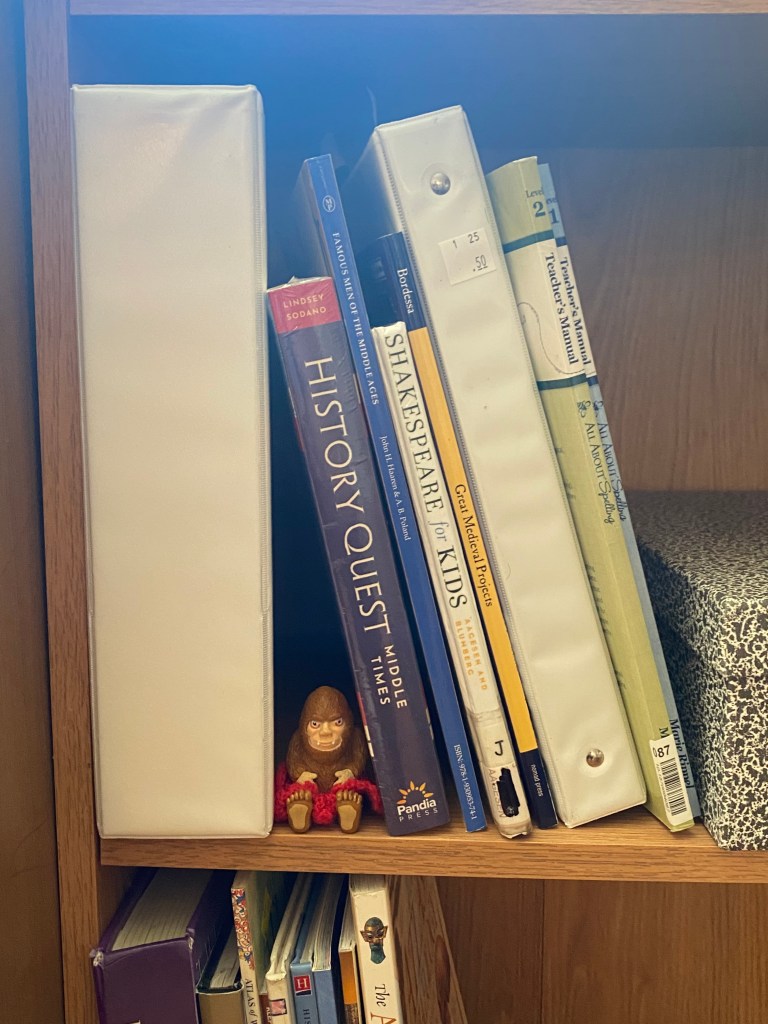
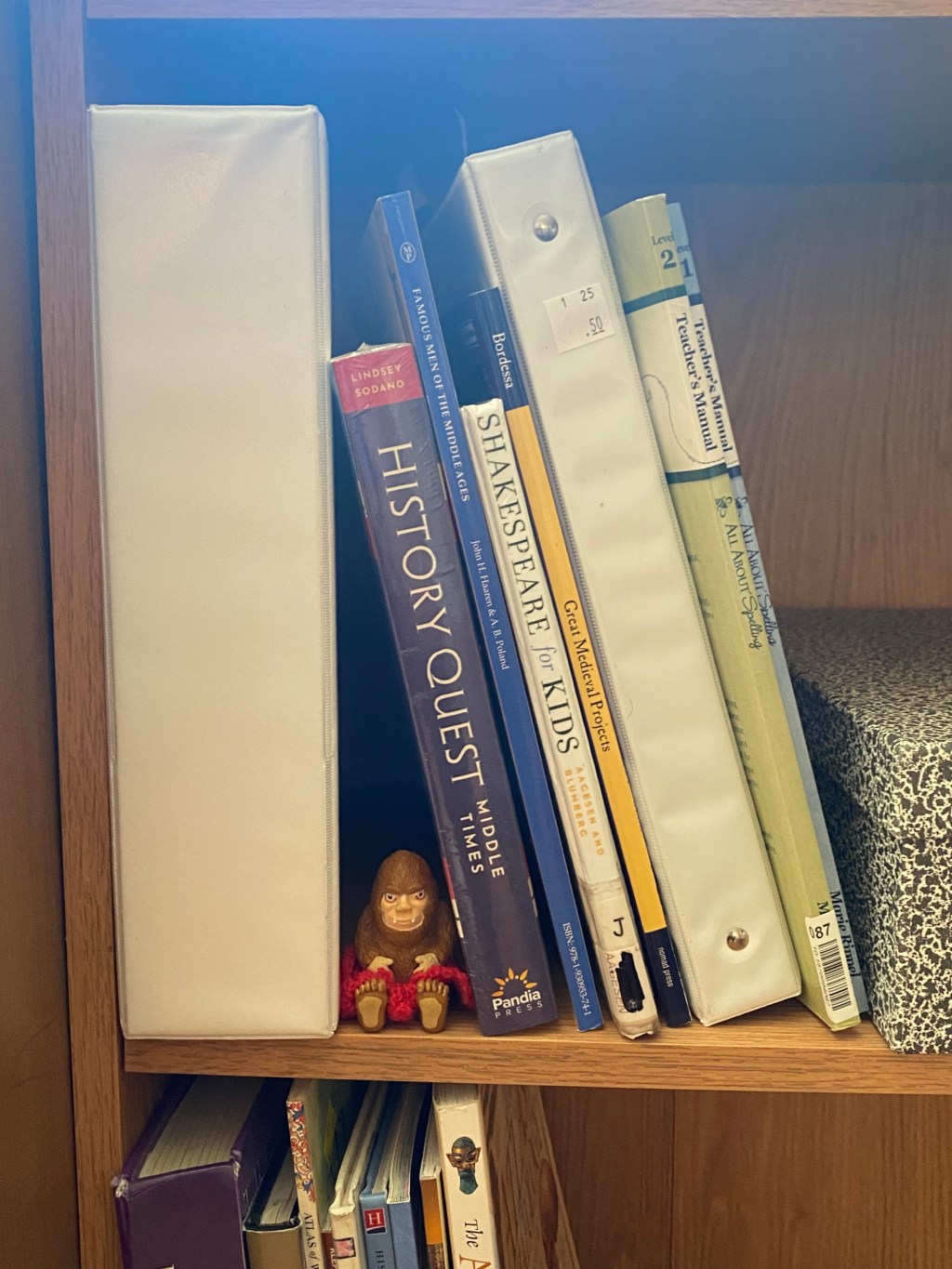
The next two are in public school, academically and socially excelling. Violet(12) is taking a class or two at the middle school but likes the pace of home. She and Moss(8) will be doing Blossom and Root literature studies this year and Pandia Press Middle Ages history. We use Science Mom for Science because it is my least favorite subject to teach. Violet is a voracious reader but struggles with spelling, so we are also adding in All About Spelling to try and fill in some of those holes. If that doesn’t seem to be working we will switch to Latin and Greek roots and give that a try.
I will wrap this up with some general curriculum tips, but also check out my individual curriculum review in my “recommendations” section.
1. Do the research, but take passionate recommendations with a grain of salt. People tend to have big feelings about things they spend money on. Look for reviews that detail a specific learning and teaching style, as well as if the reviewer is dealing with special learning considerations like dyslexia, dysgraphia, visual motor deficits, etc.
2. Don’t spend so much that you can’t change lanes if you need to. Curriculum can be incredibly expensive. A lot of people stay with a curriculum just because they have sunk costs. It isn’t worth the tears. If you are wanting to try a crazy expensive program, buy used or look for a curriculum library to try it out before committing.
3. The teachers guide isn’t the boss of you. Good curriculum will give you options and the disclaimer “do what works for you and your schedule”. Many curriculums want you to do everything, even in “everything” involves assignments that are developmentally inappropriate or just plain boring for everyone. Math-U-See gives about a million pages of problems for each topic covered; if your kid needs to do ten problems, do ten problems; if they need ten pages of problems, do ten pages. Make the curriculum work for you.
4. Prioritize relationships. A major goal of homeschooling is to nurture relationships with our children. Not only between us human folks, but their relationship with learning. Big picture, kids need to feel loved and empowered to learn. If they are crying over copywork or calling themselves stupid because they don’t understand a math problem, you are failing at relationships. A kiddo that is writing illegible poetry for fun with every word spelled wrong because they just don’t get phonics is a kid who is resilient, confident, and creative. Skills can be improved, a broken relationship with learning is a harder fix. There are backdoor ways to encourage learning that don’t crush the spirit.
5. Remember that the Industrial homeschooling curriculum institution is not your friend. They are trying to make money. Many of the same presses that create public school curriculum have homeschooling sections as well. They aren’t great at it. The world is full of independent curriculum creators with amazing work available. It is usually relatively inexpensive and in touch with what homeschoolers are really looking for. These people were driven to writing their own programs for a reason! I pull heavily from independent presses. Teachers Pay Teachers is another amazing resource for finding free-cheap resources on every topic imaginable written by teachers.
So that is Curriculum 101. If you are still here feel free to leave questions. I have tried just about everything!
*Sorry to tell you this folks but not once have I had found a curriculum that I could take out of a box and use straight through as advertised. Also never found something that was a great fit for all my kids at the same time without modification. Also? Sometimes something works great for awhile and then you run headlong into a brick learning wall and have to get really creative to dig around it. Because curriculum is just a vehicle for information, not a magic learning bullet.
 Mamasquatch the Writer
Leave a comment