Thirteen years ago I had a little boy who hated school. He was attending a private Catholic school in North Carolina at the time and it was his third school in as many years in three different states. To this day Cai is usually the smartest guy in the room, but that wasn’t cool in third grade. Throw in some neurodiversity and an exclusionary social climate and this kid was miserable.
Public school wasn’t an option. I had friends who taught in the local district who were doing their best to make their 20. The public school system has been defunded by charter schools who cherry picked the easiest/ most high performing students and left the system reeling. We decided to try homeschooling.
Fast forward through the past decade and you can catch snapshots of us trying co-ops, travel school, online public school, full time in class public school, running start, and two different nature schools. None of these programs has been a one size fit for our family, but each has provided what the kiddos needed at that moment (except the online public school which was a nightmare for everyone; but it was the best option we had during that covid year).
This year I have four kiddos still in the house and each has a different school plan. P (14) will be attending full time 8th grade. His choice after taking a couple classes a day in person last year. He loves the tech classes and doesn’t mind the rest. V (12) is taking a couple classes at the middle school but doing core work at home. She loves to read and do art and this worked very well for her last year. M(8) is mostly homeschooled, but attends Hi-Cap pull out at school and then goes to Nature school one day a week where he learns fire starting, shelter building, and social emotional stuff. And L(4) is going to try the local Lutheran preschool a couple days a week.
All of this means that I am only doing homeschool prep for two kids this year, which kind of feels like cheating! It hasn’t been this streamlined since that first year back in North Carolina.
I started my process this week by doing a quick “Scope and Sequence” check for the year. “Scope” is the term educators use to describe the content we are teaching; “Sequence” is the order in which it is being taught.
With a minor in Education (except for the last half of student teaching) and the benefit of graduating two kids from High School, I have a pretty solid grasp of what academic benchmarks my kids should be hitting to reach their current life goals. Every kiddo is different however, and sometimes their brains aren’t ready for a skill in the order that is conventionally expected, which can lead to revisiting skills in what is called The Spiral Method.
V spells at a significantly lower consistency than I would expect for such a voracious reader and writer. She has had difficulty with other areas in this skill-sequence since she was tiny (struggling to put phonemes together or understand that letter combinations were consistent in CVC words) and thanks to spell check she isn’t hindered greatly by the lag. Still, we will be doing a more consistent and therapeutic study of spelling this year.
There are two major components to consider when choosing “Scope and Sequence”. First is academic or cultural worth. Is the information they are expected to retain going to further their academic or cultural standing? Memorizing every phone number of last name of Smith in a town in 1942 could be an exercise with cognitive benefits, but is it content that other vital information is built on, v.s. say, multiplication tables or where states are located. Academic value is a wishy washy term. A lot of stuff I have had my kids learn wouldn’t be considered traditionally academic in nature. That said, is there a cognitive benefit to learning the content? And/or, is this info required to scaffold for something to come? Diagramming sentences is great if you have a kid who wants to learn languages or has a math/coding brain; maybe not so much for a kid who isn’t a visual processor.
Cultural currency is information or knowledge that allows us to connect with others in our communities and wider networks. I wore a Rammstein tee shirt to work at the middle school one day and one of my students was so excited, that every time she sees me, we catch up on which Euro metal bands she has discovered since the last time we talked. In different circles being able to discuss literature, philosophy, art, monster trucks, rocks, antique tractors, or board games can help kids to find people to connect with.
Traditionally, students have studied History, Literature, Composition, Math, Sciences, Civics, Foreign Language, and a variety of Electives. The idea behind free, public education was to create a great nation of citizens (part of the whole “if everyone gets a vote, we want them to be educated” movement after the American Revolution). In homeschooling, we get to take into account our own kiddos needs and desires and shape the “Scope” around these factors.
The second thing to keep in mind when looking at “Scope and Sequence” is what Big Life skills are being taught through the content.
In the early years decoding words, spelling, fine motor skills, gross motor skills, social emotional processes, visualizing, parsing, and memorizing are all basic life skills that kids learn through reading, writing, doing math and puzzles, playing with toys, and interacting with people. The content we use to teach these skills can greatly encourage or impede their efficacy. I’ve never had a kid throw a comic book on the floor in frustration…just saying.
By the time kids are older and have those early skills down, a lot of curriculum becomes only about content, if you let it. This is an unfortunate oversight in my opinion as big kids have just as many life skills to learn as the littles. Time management, resource management, persistence, self-efficacy in relation to academic progress, and self-motivation should all be well in hand before kids leave the house for whatever future they choose. (Pepper rolled her eyes about me harping on her to develop this stuff until she became an RA and had to deal with a floor full of people who can no independent living or learning skills.)
So once I know what I want to teach for the year, I start looking at curriculum. Okay, I usually start looking at next year’s curriculum in February. Curriculum development was kind of my thing in college and I love to see what is out and about in the world. A decade ago the options were “a lot of the same”, but these days I can find just about anything.
I am going to be writing a full blog on curriculum recommendations here in a couple weeks, but my broad statement on the topic is this: Find something that works for your teaching style AND your kids’ learning style. Curriculum is a collection of content in a specific sequence. You still have to teach the info and they still have to learn it. There will never be a perfect curriculum, but the best ones give you options on how to modify their product for a variety of learners.
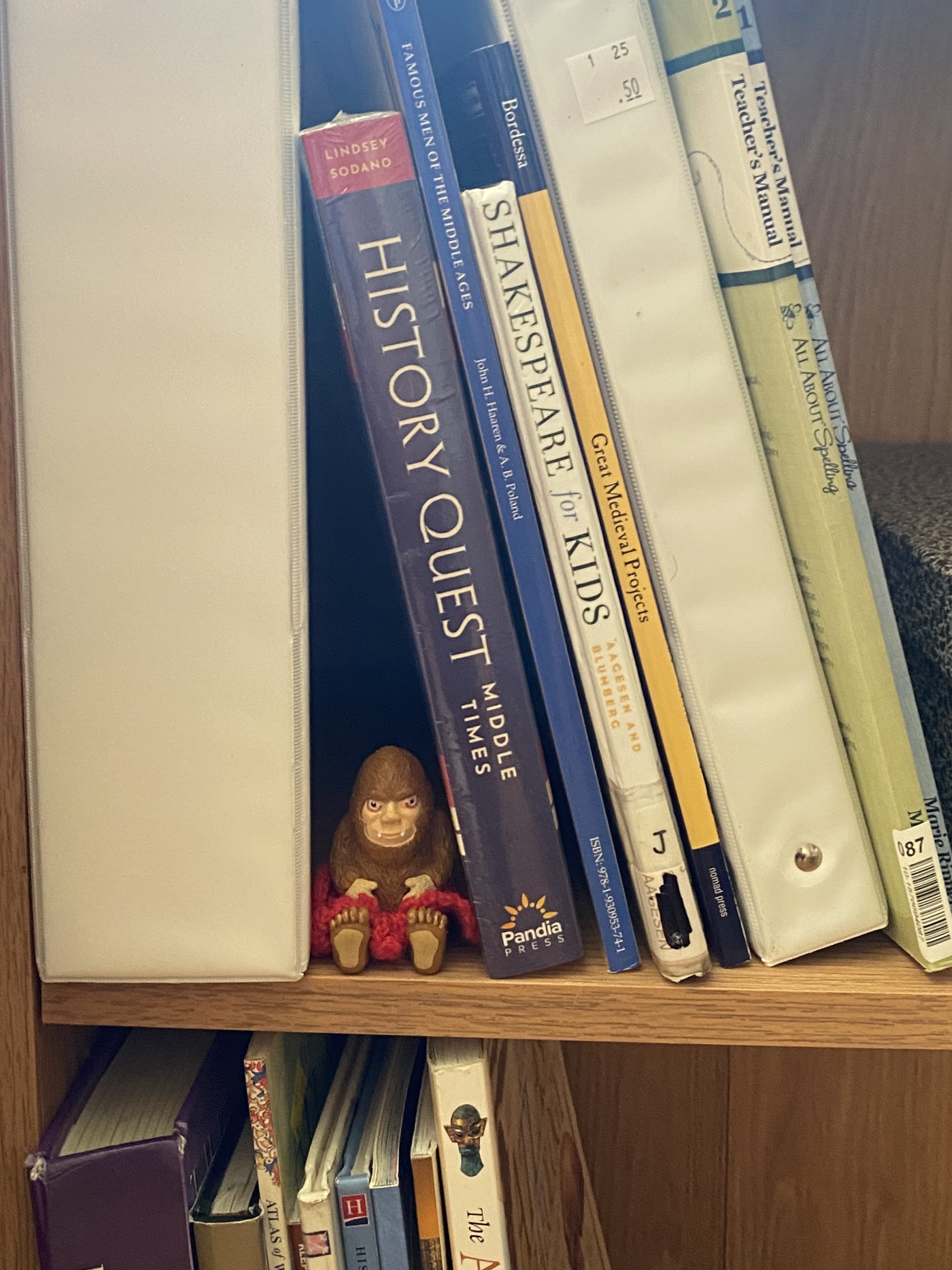
Much of today I spent printing out student notebooks, hole punching, and digging through the bookshelves to sequester the Real Books that I love to teach from. Teachers Pay Teachers, is a fantastic site to get quality lesson plans. The teachers who create them, get paid for their work. I do end up printing and hole punching that stuff as well. No-one ever told me that as an adult I would have strong opinions on printer and hole puncher attributes.
About the time this post goes to print, the family is going to be on a ferry heading up Lake Chelan toward Holden Village for two weeks. We are earning our keep by working and honestly I am very excited. It does mean that we are coming home less than two weeks before school starts. I am hoping by Hyperfocusing on school prep this week, it will mean a low stress lead up to the first day of school. Of course, we homeschool, so we can always put the whole thing off a couple extra days if we want.
 Mamasquatch the Writer
Leave a comment