Variola Major Plot Point!
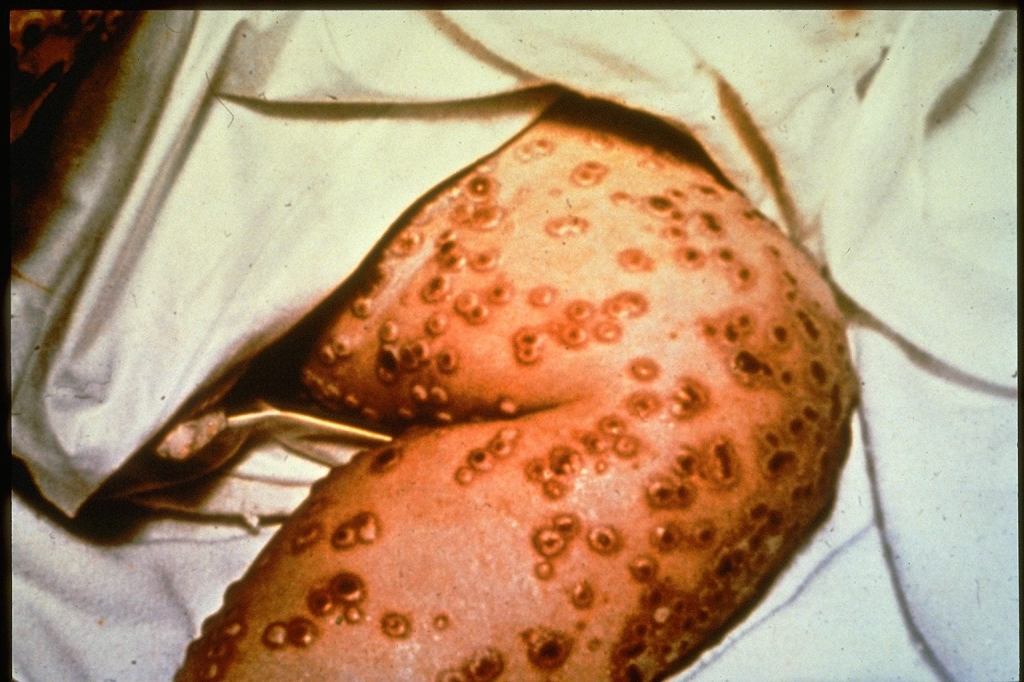
This image courtesy the CDC
Why I hyper focused on Smallpox: I stared researching my next book which takes place during the Revolutionary War fairly broadly, not knowing exactly what story I was going to tell. I stumbled on to a NPS article about how variolation won the Revolutionary war and ended up going full deep dive.
Back in Colonial times, say pre-1798, Smallpox was just about the scariest disease in America. After an almost two week incubation period the carrier would begin to exhibit symptoms such as rash, fever, pustules, and a host of other miseries. At best, one might escape with a few scars and a lifelong immunity. Worst case was the Hemorrhagic version which left one bleeding through their skin and was almost always fatal.
Because smallpox leaves one with a lifetime immunity, the small villages and cities of the American colonies were caught in a vicious cycle. Every twenty years or so enough of the population would be susceptible to contagion and an epidemic would sweep through the vulnerable—killing up to 20% of the victims.
Cotton Mather (Puritan theologian/natural philosopher/America’s first self-hype man) First began touting the idea of Variolation based on an explanation of the procedure by Onesimus, a man Mather had enslaved in 1721. Variolation is the procedure where dried scabs from a previous smallpox victim are introduced into a cut on the patient’s skin or ground into dust and aspirated.
The procedure generally leads to a more minor case of the disease with far lower mortality rates. It was a common enough practice around the world that Lady Mary Wortley Montagu learned of it in India and promoted the practice in England around the same time.
The practice of variolation was not uncontroversial on either continent. Mather was a Puritan rarity with many of his counterparts arguing that smallpox was a tool wielded by God to weed out sinners, or simply because he felt like it? Regardless, interfering was considered a sin.
In the 1720’s and again in 1751-52 and 1764, smallpox ravaged Boston and Philadelphia. The 1764 epidemic left upwards of 18% of Boston victims dead. While this led to an upswing in variolation, it was not until the 1775 epidemic that it was considered widespread.
British soldiers often came to the American colonies with their smallpox card already punched. Variola minor was endemic in the Mother Country thanks to a large population constantly making new hosts, so while American troops were often exposed and then laid up for weeks in camp, dying by the mass gravefull, the Brits were tramping around the countryside healthy and hale.
This was all well and good (for the white colonizers) when The British and Americans were on the same side, but come 1775 there had been a bit of a disagreement over who ought to pay for all those violent walkabouts of the past twenty years and suddenly those healthy Brits had a huge advantage (although technically, General Howe’s army fell ill to the Boston 1775 epidemic to such a degree that everything ground to a halt until the British left Boston to regroup.)
Still, every time George Washington or his generals stopped to scratch their noses, it seemed like half the army was down with smallpox. After losing much of the Northern campaign, and understanding how vulnerable his troops were to the disease, by the winter of 1777 Washington required variolation for all of his soldiers. (I put a link to an article that details this whole element of the Revolutionary War in my Stuff I find Interesting section)
It was another twenty years before Dr. Edward Jenner published information on a vaccine for smallpox, and nearly two hundred before the World Health Organization declared the disease eradicated.
Fun Facts:
Variola Minor scabs were highly sought after for variolation procedures as they often produced a more minor reaction.
Variolation was often performed by Blacksmiths, tax collectors, midwives, and Traveling Clergy.
Cuts were generally made on the forearm.
Grinding and Aspirating, vs Scab in the incision methods were from different parts of the world. Incision was the preferred method in England.
A note on citations: Generally I am a huge fan of citing my work and giving credit where credit is due, however often when I am hyper focusing, I am scrawling notes or mass consuming information from a variety of sources that may have overlap. I have tried to put all of the resources I used in my “Things I find Useful” section under a specific topic heading.
 Mamasquatch the Writer
Leave a comment